

Generative AI and GraphRAG: How EIMT’s Tech Curriculum Addresses Enterprise Architecture Challenges
Home / Generative AI and GraphRAG: How EIMT’s Tech Curriculum Addresses Enterprise Architecture Challenges
Technology
The European Institute of Management and Technology (EIMT) is a Swiss-based private higher education institution offering fully online educational programs in business, management, and technology. In the context of its tech curriculum addressing enterprise architecture challenges in reference to generative AI and GraphRAG (Graph Retrieval-Augmented Generation), EIMT actually blends the technology coursework with strategic management training.
Hence, the purpose is to help learners become skilled at solving complex Enterprise Architecture (EA) bottlenecks and ensure that architects and data scientists stay relevant in their current jobs by training them to build reliable, scalable, and explainable AI systems for enterprise environments.
Why Enterprise Architecture Needs More Than Generative AI
The reason enterprise architecture needs more than generative AI is that it is not possible for these models to fix messy data, missing business context, weak governance, or legacy system debt. To say otherwise, while generative AI is designed to speed up drafting, ideation, and documentation, it can’t effectively turn experiments into business value that can be trusted unless they have structured foundations and human-machine decision design, as established by the World Economic Forum report.
How Enterprise Architecture Evolves Around AI
Enterprise architecture is no longer considered static system design and application integration. In other words, a tech setup of a company can no longer be treated like it is a fixed blueprint, but instead it must evolve to match the business goals and rapid market changes.
Enterprise architecture is now shifting toward something called designing context-rich, smartly governed, and agentic systems. Far from bolting artificial intelligence onto existing apps, engineers now focus on utilizing AI as a core architectural layer connecting business context, data and workflows. This means, for software engineers, AI is not just a side feature, but an innovative tech to build apps to connect a company’s data, daily tasks, and business rules.
Moving from static charts to real-time planning
AI-assisted tools now build and update system maps and business diagrams automatically. This allows architects to spend less time drawing charts from scratch and more time checking accuracy, business goals, and trade-offs, like weighing the pros, cons, and risks of different options when you cannot achieve every goal at once.
From standalone models to connected AI agents
Earlier versions of machine learning models were designed to carry out the task of building and launching single models on their own. Today, they are known as modern systems that link different AI agents together to search data, reason through problems, use software tools, and manage live business tasks automatically.
Moving computing closer to the work
Modern AI systems or architectures are capable of different sorts of tasks, including bringing smart tools and safe data access right to where work actually happens. This setup does not allow problems accessing the cloud, local company servers, and nearby edge devices.
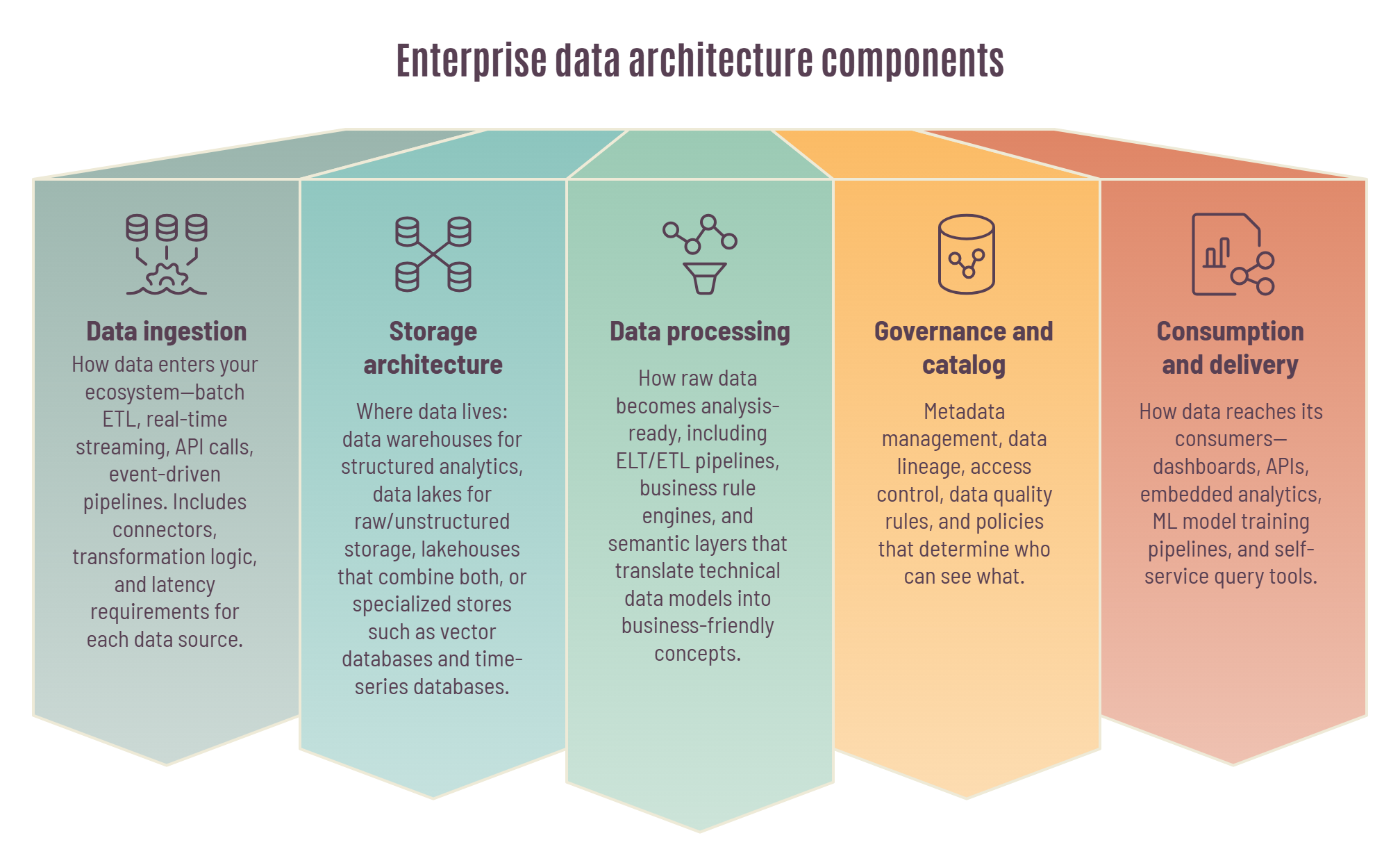
Moving from basic data to real business context
The value of clean data is surely there in the context of training AI models, but AI also needs to understand how a business actually works to make reliable decisions. This means connecting data across different tools such as ERP, CRM, and transaction platforms. The purpose is to enable AI systems to see the big picture and make informed decisions.
An overview of the growing use of Generative AI in enterprise operations, decision-making, and knowledge management
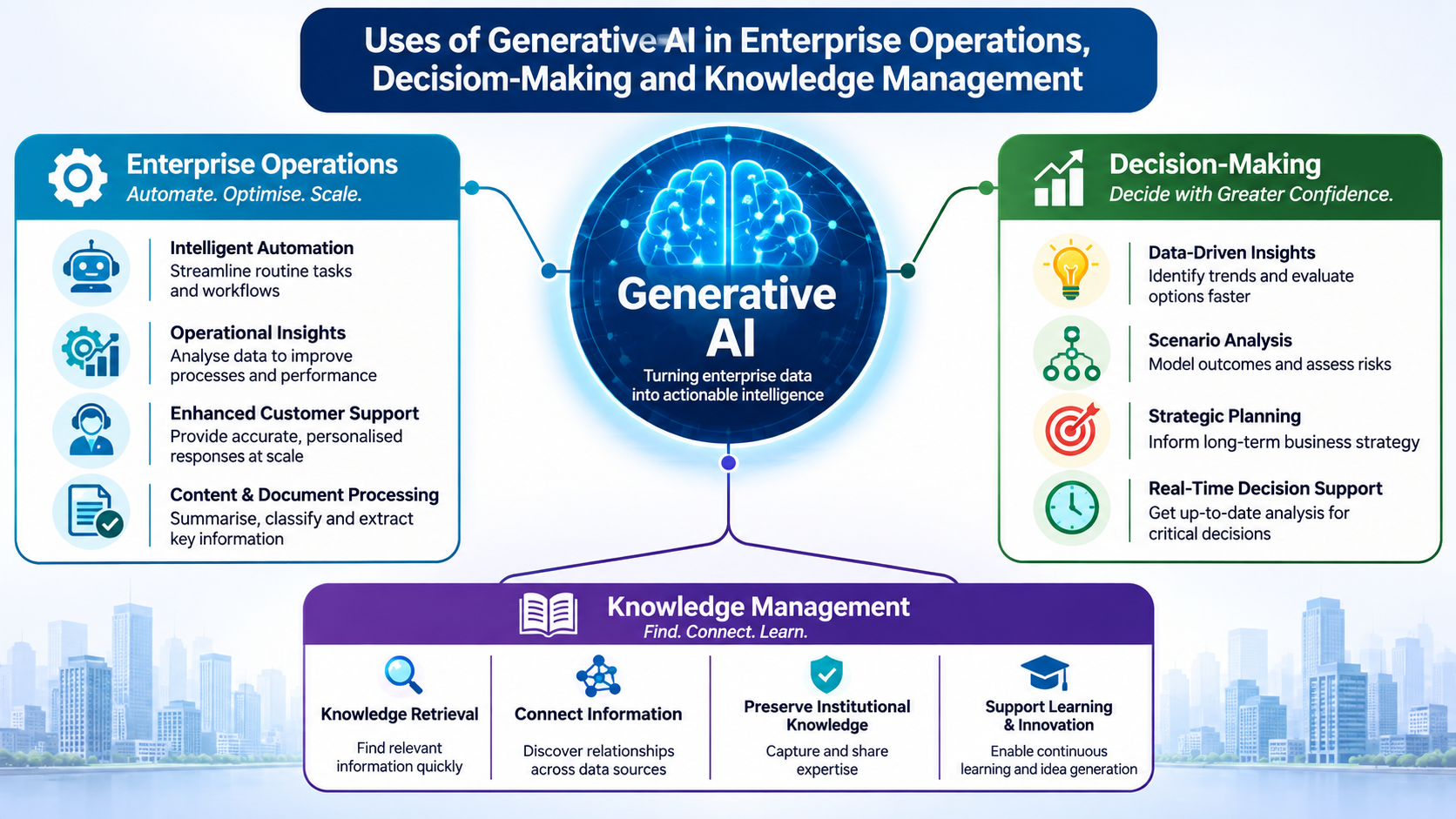
Generative AI is being very useful for businesses as a technological factor to move past basic automation and file storage. Today, it is capable of creating new content, answering questions in plain language, and generating insights quickly across daily workflows.
The purpose here is not to replace human judgment but to enable companies to use Gen AI technology to expedite routine tasks, locate useful data, and help people make better decisions. Interestingly, throughout this process, the relevance of human workers remains valuable to guide and oversee the AI-generated results.
Growing use of Gen AI in enterprise operations:
- Gen AI can generate drafts for reports, contracts, proposals, and marketing copy, while assisting with code suggestions and routine IT or HR requests.
- It powers conversational assistants and agent-assist tools that draft responses, summarize tickets, and speed up issue resolution.
- The technology helps teams create or update operational guides, standard operating procedures, and technical documentation from current data
Growing use of Gen AI in decision-making:
- Gen AI allows executives and analysts to distill long reports, scientific literature, or customer feedback into key takeaways.
- It allows teams to test "what-if" scenarios, flag anomalies, and surface strategic options.
- Organizations rely on AI recommendations in the context of human judgment to avoid bias.
Growing Use of Gen AI in knowledge management
- Gen AI allows conversational search wherein employees ask questions and get grounded answers taken from approved internal sources.
- AI simplifies the way information is consumed, whether it means summarising long-winded threads, drafting FAQs or guides, and flagging outdated information or knowledge gaps.
- If paired with RAG (Retrieval Augmented Generation), Gen AI turns static databases into interactive tools that allow teams/people to chat and explore stored information.
Why conventional Large Language Models (LLMs) can struggle with complex, interconnected, and organization-specific information
Conventional Large Language Models (LLMs) are less capable of performing tasks that require processing complex, organisation-specific data. The main reason behind this is that they rely on static, public training data. For example, if an LLM is fed static (outdated information), the model will not give real-time updates, or generate responses that are latest. And if the model is fed public data, it may fail at tasks that require private, internal, or specialised context. In addition, conventional LLMs (when fed public data) lack direct access to private company files, internal databases, and real-time updates.
Moreover, LLMs rely on statistical patterns rather than true logical reasoning when predicting words. This is why they often lose track of context or hallucinate when faced with deeply interconnected business rules. In the absence of frameworks like Retrieval-Augmented Generation (RAG) or Knowledge Graphs to map out hidden relationships, standard LLM models can have a hard time accurately connecting scattered internal facts or safely enforcing strict company access permissions.
GraphRAG: An approach that combines knowledge graphs with Retrieval-Augmented Generation (RAG)
GraphRAG enhances Retrieval-Augmented Generation (RAG), and one of the best ways it does so is by structuring data into a knowledge graph of entities (nodes) and relationships (edges), rather than relying solely on isolated vector text chunks. Throughout the process of indexing, GraphRAG extracts entities, connections, and community summaries across documents.
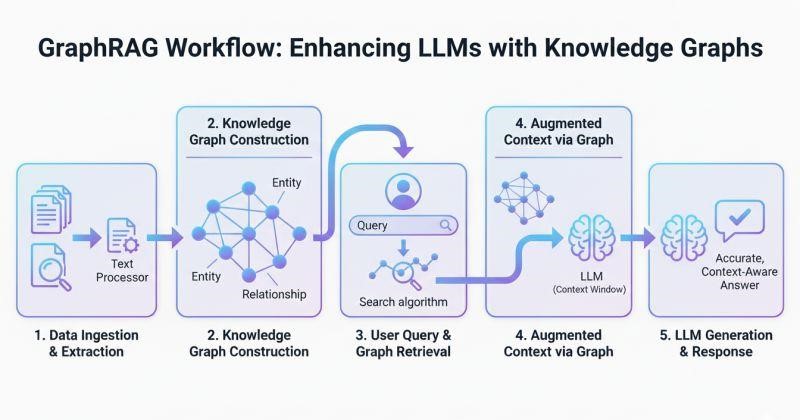
In addition, it organizes documents by identifying key people or topics, mapping how they relate, and summarizing major themes. This is how it follows these mapped connections to gather both specific facts and the bigger picture, and then passes this connected information to an AI in order to perform tasks such as answering complex, multi-step questions, summarizing entire datasets, and explaining its reasoning better than standard search methods (RAG).
|
Traditional RAG |
GraphRAG |
|
Primarily retrieves relevant information chunks. |
Can retrieve information through connected entities and relationships. |
|
Works well for focused document-based queries. |
Particularly useful for complex, relationship-oriented queries. |
|
Often relies on vector or keyword retrieval. |
Uses knowledge graph structures alongside retrieval techniques. |
|
Provides context from retrieved passages. |
Can provide broader context from connected information. |
How EIMT’s Technology-Oriented Curriculum Addresses Enterprise Architecture Challenges
According to its official statements, the European Institute of Management and Technology (EIMT) is committed to redefining the paradigm of education on a global scale by helping students develop tech skills and leadership competencies needed to lead teams in the dynamic landscapes of global industries. The institution serves as a functional bridge between technical systems and executive strategy through its technology-oriented online DBA curriculum.
Instead of focusing on theoretical regurgitation of facts, students are taught problem-solving skills by integrating in its program digital transformation, emerging technologies and corporate governance into core business coursework. EIMT’s tech curriculum involves practitioner-based applied research, the purpose of which is to train learners how to investigate organizational bottlenecks using qualitative and quantitative methodologies.
In the following discussion, we are highlighting how EIMT’s tech-oriented online DBA curriculum addresses enterprise architecture challenges.
Strategic management and leadership for AI-driven enterprise transformation
An organization requires a clear strategy to introduce Generative AI and GraphRAG technologies. They must take into account how these technologies should address operational challenges, what is the best way to integrate these technologies with existing systems, and what are the expected outcomes from such implementation. Another thing essential in this regard is strategic direction, which is vital to ensure AI investments remain connected to tech initiatives and generate great business value.
Since EIMT focuses on strategic management and leadership development, they are relevant for students to understand how to analyze organizational priorities, allocate resources, assess business opportunities, and align technology-related decisions with long-term objectives. This can be understood with the example that a business leader who makes a thorough analysis of GraphRAG, evaluating its capability to manage enterprise knowledge, must consider whether the technology can improve information retrieval, reduce knowledge gaps, support decision-making, or increase operational efficiency.
Strategic leadership also plays a key role in managing the change of legacy information systems into a more intelligent business environment. Therefore, leaders need to coordinate technology teams, department heads, and stakeholders while ensuring that no problem surfaces during digital transformation that supports the organization’s direction.
Entrepreneurship and innovation for emerging AI opportunities
While generative AI is creating new opportunities for business growth, GraphRAG takes it further by helping companies retrieve information through relationships between connected business records. In other words, generative AI is opening up new ways for businesses to innovate, whereas GraphRAG helps organizations find information through the links between connected people, ideas, and records.
However, finding a good use for AI requires caution. For example, businesses also need to verify if the idea makes financial sense, how hard it is to build, what resources it requires, and how it will affect their current operations.
EIMT offers entrepreneurship and innovation courses that help students learn how to spot new opportunities and see how fresh ideas drive business growth. Professionals can use this approach to explore the significance of GraphRAG in the context of how it might improve services, simplify daily work, or launch new AI tools.
For example, a bank could use it to link customer profiles, financial products, rules, and compliance records. However, a leader must check whether utilizing the technology solves a real business need, or whether it is cost-efficient. That said, assessing innovation from both a commercial and company perspective is important, as enterprises are leaning more toward integrating Gen AI into their core business operations.
Corporate governance and responsible AI adoption
EIMT offers corporate governance in its curriculum for learners to understand organizational responsibilities and how they work. The curriculum provides a management perspective on many aspects, including ethical decision-making, accountability, and the value of establishing relevant organisational controls.
For business leaders, EIMT’s corporate governance can be applied as a principle when developing AI governance frameworks, defining responsibilities for technology teams, and establishing procedures for monitoring AI-supported decisions. Master of Computer Science in AI & Data Science and technical research offered by EIMT focus on structured data pipelines, big cloud dataset management, and advanced retrieval architectures (such as GraphRAG) to reduce hallucinations and connect multi-department data.
Aligning technical execution with business strategy
What pans out the main failure point in enterprise architecture is lack of connection between IT execution and execution business goals. Therefore, EIMT’s programs structured around mandatory applied projects and theses prove useful for learners, enabling them to solve real architectural bottlenecks within their own organizations under faculty mentorship.
Moreover, the institution pairs technical modules with business programs like the Executive MBA, covering digital economy management and operational optimization. This helps professionals oversee digital transformation.
Advanced research capabilities to pave tech decisions backed by evidence
EIMT has been transparent in its approach to emphasize research capability and advanced research design and methodologies, and to connect with the problems businesses have been facing: determining whether a technology actually delivers the expected benefits. These are the learning areas where students can develop the relevant skills to investigate organisational problems, architectural trade-offs, and test generative AI solutions against real business needs.
For example, before an enterprise plans to deploy GraphRAG for the purpose of improving internal knowledge management, it needs to understand the existing information retrieval problems, figure out the departments that are most affected, and establish performance metrics. Once GraphRAG is implemented, the company must evaluate whether employees retrieve accurate context and whether response quality has improved across connected sources.
Curriculum and Applied Research: Solving Real-World Enterprise Tech Challenges
EIMT offers technology-focused DBA curriculum that helps experienced professionals connect new AI tools with their existing computer systems in their company. Rather than focusing on studying the code behind generative AI and GraphRAG, learners can use the coursework and research projects to see how these tools solve real business problems.
The program teaches them to look at how to use knowledge graphs to organize company data, how to connect new AI tools to legacy systems, and how to set clear rules for safe AI use. They also learn how GraphRAG improves data access and decision-making without having to build the AI software from the ground up.
Since a DBA (Doctor of Business Administration) mainly focuses on business leadership rather than pure coding, EIMT’s curriculum prepares working professionals to make smart, practical choices that guide their company’s tech strategy and growth.
Developing leadership capabilities for an interconnected enterprise environment
Today is a world wherein any tech decision about cloud systems, data platforms, and AI correspondingly affects every part of a business, from finance and marketing to daily operations. This is why companies look for experienced professionals or leaders who know how to lead tech teams and non-technical managers so that new tools do not create friction and serve the intended organizational goal properly.
EIMT’s tech curriculum, like online DBA programs, builds these skills by combining lessons in leadership, innovation, and governance with practical research. For example, when launching a GraphRAG system across the company, it needs data engineers, security experts, and department heads to work together.
While the role of tech specialists here is to build the software, business leaders ensure that clear goals are set, budgets are managed, and data is safe. Hence, by teaching managers how to judge the real business value and potential risks of Generative AI and GraphRAG, EIMT prepares them to lead successful, company-wide tech upgrades.
Concluding Statements
Generative AI and GraphRAG are playing an instrumental role in creating new possibilities for enterprise knowledge management, data integration, and intelligent decision-making. However, it is worth noting that adopting Generative AI and GraphRAG successfully relies on more than just technological capabilities. It is also essential for companies to address complex challenges involving data governance, security, and strategic planning. This brings the significance of business leadership into the spotlight.
EIMT’s tech curriculum, like the online DBA, offers a research-driven learning pathway that includes strategic management, innovation, corporate governance, and advanced research capabilities. These are the competencies useful for professionals who seek to evaluate emerging technologies, manage digital transformation, and align AI initiatives with organisational objectives. As companies are embracing AI-driven environments, business leaders who combine strategic thinking with evidence-based decision-making will play an important role in shaping sustainable business transformation.
The EIMT Editorial Team is made up of academic editors, faculty contributors, curriculum specialists, instructional designers, education researchers, programme managers, quality assurance professionals, content strategists, and subject matter experts...
Frequently Asked Questions
What is the difference between Generative AI and GraphRAG?
How does GraphRAG improve enterprise knowledge management?
Can GraphRAG integrate with existing enterprise architecture?
What are the limitations of GraphRAG in business applications?
Why is enterprise data governance important for Generative AI?
How can business leaders prepare for AI-driven digital transformation?
How does EIMT's Online DBA address technology management and innovation?
Latest Updates & Articles
Stay Connected !! To check out what is happening at EIMT read our latest blogs and articles.

Nov 17, 2026