


Which Jobs Will AI Replace by 2030? Top Careers At Risk and The Skills That Could Protect You
Home / Which Jobs Will AI Replace by 2030? Top Careers At Risk and The Skills That Could Protect You
Technology
Will people really lose their jobs to AI?
Questions like this are abundant on different digital platforms these days. While there is no certain answer confirming the suspicion of AI-related job displacement in future, prominent tech leaders, AI pioneers, and economic research groups keep predicting otherwise. According to them, AI-driven unemployment is surely on the horizon, just the exact deadline is not confirmed.
Here are the statements of some world-renowned personalities in the tech industry predicting about AI job replacement/displacement.
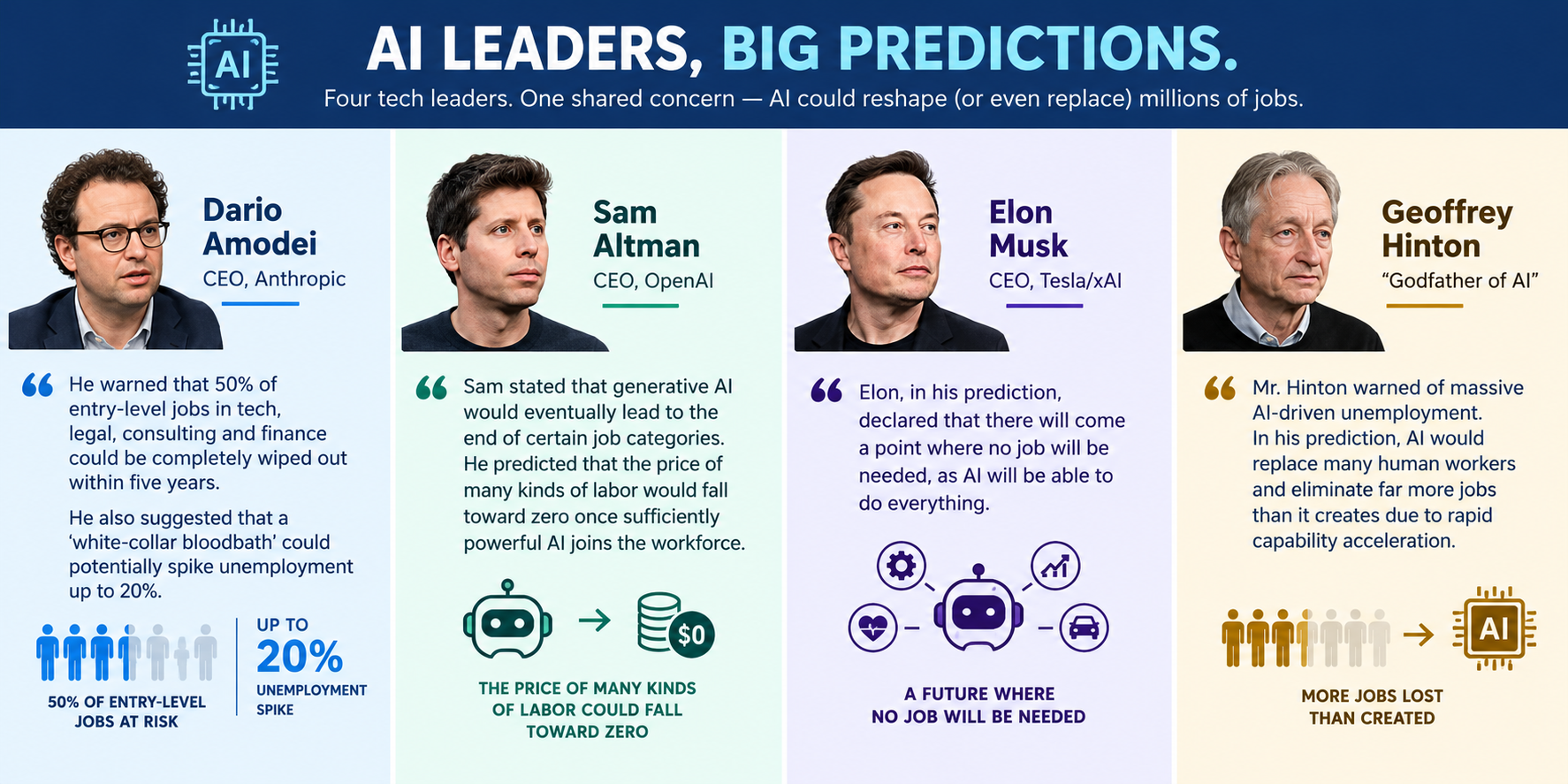
Dario Amodei (CEO, Anthropic) -
- He warned that 50% of entry-level jobs in tech, legal, consulting, and finance could be completely wiped out within five years.
- He also suggested that a "white-collar bloodbath" could potentially spike unemployment up to 20%.
Sam Altman (CEO, OpenAI) -
- Sam stated that generative AI would eventually lead to the end of certain job categories. He predicted that the price of many kinds of labor would fall toward zero once sufficiently powerful AI joins the workforce.
Elon Musk (CEO, Tesla/xAI) -
- Elon, in his prediction, declared that there will come a point where no job will be needed, as AI will be able to do everything.
Geoffrey Hinton ("Godfather of AI") -
- Mr. Hinton warned of massive AI-driven unemployment. In his prediction, AI would replace many human workers and eliminate far more jobs than it creates due to rapid capability acceleration.
Now let's take a look at how global stats talk about AI job replacements across global industries.
Global AI job Statistics
The World Economic Forum Future of Jobs Report -
- AI is projected to create 170 million new jobs while displacing 92 million jobs globally by 2030, resulting in a net growth of 78 million jobs.
LinkedIn data -
- AI has already added 1.3 million new roles (such as AI Engineers and Data Annotators) along with over 600,000 data center jobs.
PwC's AI Jobs Barometer -
- Companies that utilize AI have tripled their lead in workforce productivity growth compared to the companies least exposed to AI.
- Jobs 'professionalized' by AI are growing twice as fast with 42% higher wage growth.
In addition, companies are also prioritizing talent that can deploy real-world AI systems, something attributed to the latest phase of AI adoption creating high demand for experienced engineers (aka Forward-Deployed Engineers) who can identify problems that AI can solve.
Is that too frightening?
Well, sorry if this article sounds like a doomsayer about AI related job displacement/replacement for future employment. This is not its intention. In fact, it serves as an informative guidebook about top careers on the verge of being replaced by intelligent machines, and also accentuating top skills you must build to stay relevant in your employment.
Before elaborating anything further, please understand that answering any question about AI-related job replacement is more nuanced than jotting down a list of careers that the intelligent machines will vanish. Yes, Artificial intelligence may automate some tasks within most professions, cut down demand for some routine roles, and transform the job responsibilities of others.
Having said that - some jobs may encounter major declines, while new postings may appear in AI development, implementation, cybersecurity, data governance and human-AI-collaboration.
Does that mean every job involving a computer is at the risk of being replaced by AI? How much of a role can be automated? Will the future work depend on human judgment, interpersonal trust, physical dexterity or accountability? This guide examines these factors, including the careers most exposed to AI by 2030.
Will AI really replace jobs by 2030?
Though nothing can be said with 100% certainty and confidence, Artifical Intelligence most likely will eliminate or reduce the need for certain jobs by 2030. In fact, repetitive, digitally processed tasks will face elimination or replacement by the intelligent machines.
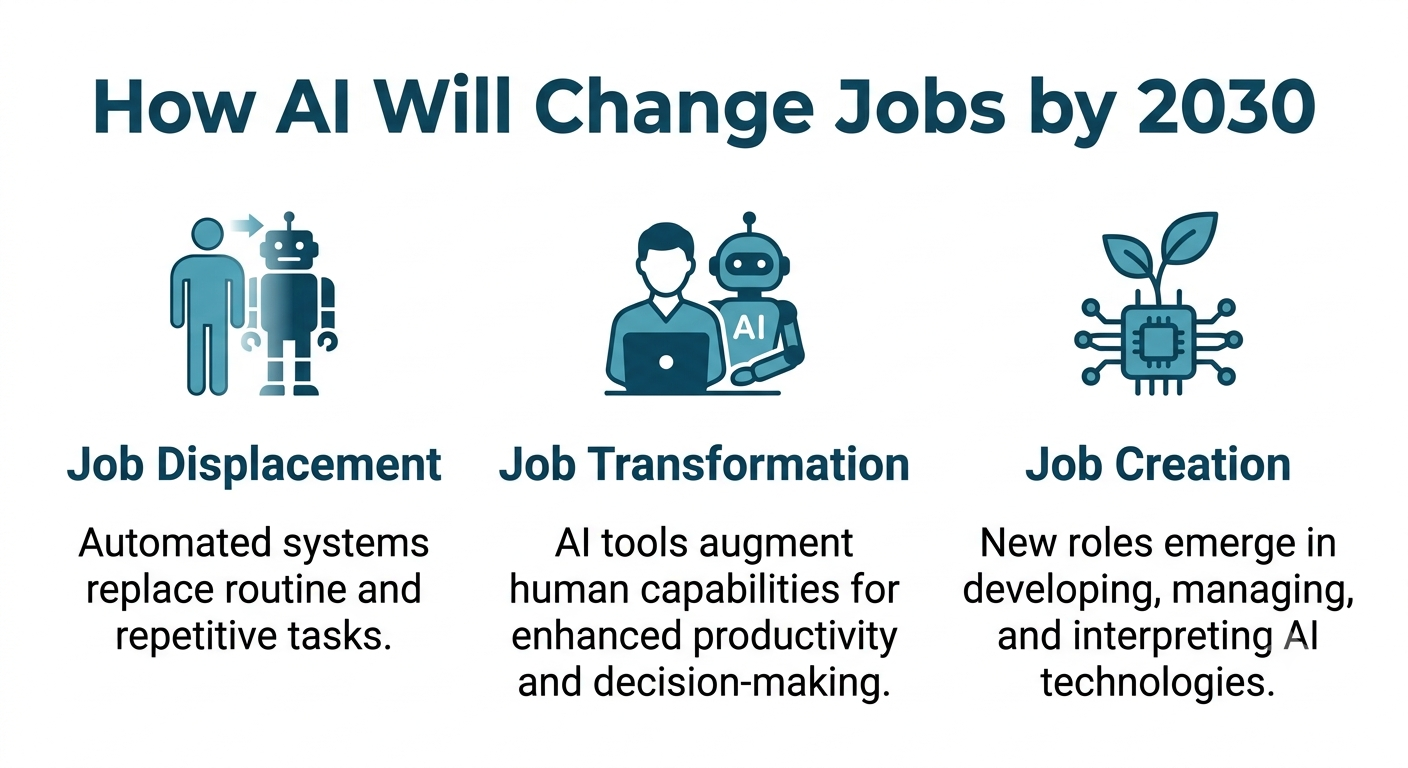
AI will likely cause three distinct transformations in jobs. They are -
- Job displacement: This means that AI or automation will likely displace jobs previously handled by human employees causing reduction in the number of people required for particular roles.
- Job transformation: An era of AI-assisted workflow will likely happen in which human employees continue working in the same occupation but use AI to complete routine tasks more quickly or take on different responsibilities.
- Job creation: It means that companies may hire people for new or expanding activities, such as AI implementation, model evaluation, data governance and automated-system security.
Lets understand it with an example. An AI system may draft routine customer service responses, but a human employee may still be required to resolve a billing dispute, handle a distressed customer or authorise a refund. For example, travel booking platforms have deployed their AI travel assistant to streamline travel itinerary of passengers by answering their travel-related questions, or escalating their queries to a human agent for urgent resolution of exceptional concerns.
It doesn’t mean ruling out human workers. They are necessary but routine tasks like handling customer queries will be done by AI. It goes the same with financial jobs where AI can prepare a financial summary, while an expert accountant oversees tasks like checking assumptions, interpreting unusual transactions, and meeting applicable professional obligations.
The logic that AI exposure means job loss is divisive. The greatest risk rests not on the jobs themselves, but on workers who fail to adapt. AI job replacement may be on horizon, but professionals who use AI are sure to replace those who do not use AI. Also noteworthy in this regard is that while entire occupations are not to vanish overnight, it is important for people to adapt to the evolving AI-dominated business landscape to stay relevant.
Which jobs are most at risk of AI replacement by 2030?
The below-mentioned jobs are those that are at higher risk of being automated. The risk ratings reflect the qualitative assessments of how common tasks can be automated, while recognizing that adoption varies by industry, employer and country.
|
Job or occupation |
AI-related risk by 2030 |
Tasks AI could automate |
What may remain human-led |
|
Data entry operators |
High |
Transcribing, extracting and validating structured data |
Resolving discrepancies, handling exceptions |
|
Data processing and records clerks |
High |
Classifying, updating and retrieving records |
Audits, complex records and accountability |
|
Basic customer service representatives |
High |
Answering routine queries, tracking orders, providing standard information |
Complaints, sensitive cases and negotiation |
|
Telemarketing and scripted sales roles |
High |
Automated outreach, scripted conversations, lead qualification |
Relationship-based selling and complex deals |
|
Administrative and clerical assistants |
High |
Scheduling, document drafting, meeting summaries and routine correspondence |
Coordination, discretion and stakeholder management |
|
Bookkeeping and payroll clerks |
High |
Transaction categorisation, reconciliations and routine payroll processing |
Exception handling, controls and compliance |
|
Basic transcriptionists |
High |
Converting speech into text and generating summaries |
Correcting specialist terminology and verifying critical records |
|
Routine content writers |
High |
Producing standard product descriptions, basic articles and repetitive marketing copy |
Original reporting, editorial judgement and brand strategy |
|
Basic translation and localisation roles |
High |
First-draft translation and standardised text localisation |
Cultural adaptation, legal accuracy and specialist review |
|
Junior research and reporting assistants |
Moderate to high |
Gathering information, summarising documents and producing first drafts |
Source validation, interpretation and defensible conclusions |
|
Basic graphic design production roles |
Moderate to high |
Generating standard layouts, resizing assets and creating template-based visuals |
Art direction, original concepts and complex client requirements |
|
Entry-level software development tasks |
Moderate to high |
Boilerplate code, test generation, documentation and debugging assistance |
Architecture, security, system integration and requirements decisions |
|
Routine financial analysis support |
Moderate to high |
Standard spreadsheet analysis, report preparation and scenario summaries |
Investment judgement, risk assessment and accountability |
|
Recruitment coordination |
Moderate to high |
CV screening, interview scheduling and routine candidate communication |
Candidate assessment, negotiation and sensitive decisions |
Jobs That AI will Likely to Replace by 2030
What jobs AI is going to replace in future? Is my job AI-proof? Questions like these are really concerning for job-holders around the world. And why not - nobody wants to be replaced by AI. Listed below are some top jobs that experts believe will be taken over by smart machines. Please note these are anticipated jobs to be replaced by artificial intelligence. They don’t mean that the doors for human intervention are closed.
Data Entry Operators and Data Processing Clerks
Data entry is believed to be one of the most at-risk jobs of being replaced by smart machines, considering much of what tasks it involves are AI-doable; from transferring to classifying and updating information. So, basically, if a company has deployed an AI-enabled system designed to extract data from invoices, forms, emails, and scanned documents, it would surely mean that they can populate databases, identify missing fields and flag inconsistencies at a much faster rate than humanly possible. The implication of these jobs being replaced by AI is that employers may not need many people to process the same volume of information.
Helpful skills to learn -
- Spreadsheet automation
- Database management
- Data-quality assurance
- Workflow design and the ability to investigate errors that automated systems can’t resolve.
Customer Service Representatives and Call Center Agents
The customer service role is at a higher risk of being automated, as tools like chatbot and virtual assistants process a broader range of customer queries and requests. The AI-powered voice agents and chat systems can process tasks, such as -
- Answer common questions
- Explain standard policies
- Track deliveries
- Help with account information and route requests to the appropriate department.
Obviously, customer service teams that handle high volumes of enquiries will face possible replacement by the sophisticated agentic systems. But there are areas for humans still safe, such as complex complaints, emotionally charged interactions, unusual billing issues and negotiations that still require a human representative.
So, the risk of these jobs being replaced by AI is higher, as businesses are moving ahead with automating a large number of similar interactions without needing a human to handle them one by one.
Helpful skills to learn -
- Conflict resolution
- Active listening
- Product knowledge
- Customer relationship management (CRM)
- Complaint handling
- AI-assisted support operations.
Administrative Assistants and Clerical Workers
These job roles are a greater risk of being replaced by AI, as smart tools, when connected to workplace applications can draft emails, summarize meetings, organise calendars, prepare reports, search documents and help with routine scheduling.
As a result - time needed to handle clerical work can greatly be reduced, thus declining the demand for routine administrative positions, in some organisations.
Helpful skills to learn -
- Project coordination
- Process improvement
- Advanced office software
- Stakeholder communication
- Information governance
- AI-assisted workflow management
Bookkeeping, Payroll and Routine Accounting Support
Gone are the days when the departments dedicated to handling booking, payroll and routine account support were 100% human dominated. That’s because AI-enabled accounting software can categorise transactions, match invoices, flag unusual entries and help with reconciliations, apart from preparing draft financial reports. Payroll systems enabled by AI can also automate routine calculations and processing faster and more accurately. Therefore, the fallout of these AI-powered capabilities may reduce the demand for employees who mostly handle high-volume transactions.
Does that mean human involvement is not needed?
Well, that’s not the case. Human control is needed to control and take accountability of financial records. Qualified human review is non-negotiable to deal with incorrect entries, unusual transactions, tax questions and regulatory obligations. What AI can do doesn't automatically satisfy legal or professional requirements.
Helpful skills to learn -
- Financial analysis
- Tax and regulatory knowledge
- Internal controls
- Audit procedures
- Enterprise resource planning (ERP) systems and the ability to investigate anomalies.
- Ability to understand both financial principles and automation.
Routine Content Writers, Copywriters and Proofreaders
When generative AI was launched, the initial purpose was to replace blue collar, manual, and routine data-entry or clerical jobs. However, early automation and industry shifts adversely impacted the creative and knowledge-based jobs like content writing, copywriting, and proofreading.
Generative AI can mass-produce content of any format today, be it text, audio, video, and other formats, and with the speed and accuracy not humanly possible. This is not an overstatement. Capabilities of Gen AI systems are already proven in handling tasks like correcting grammar, suggesting headlines, creating engaging visuals, and adapting content to different formats.
Obviously, professionals involved in content production may feel the impact of being replaced by AI, though it is still debatable if all writing careers are over because of AI. The reason is that high-quality editorial work in the creative field requires original research, source verification, interviewing, audience understanding, strategic messaging and different editorial perspectives. And one more thing - AI-generated content may contain fabricated details, outdated data or unverified claims. That’s why human supervision becomes unavoidable.
Helpful Skills to Learn -
- Research and fact-checking
- SEO strategy
- Interviewing, editorial judgement
- Subject-matter expertise
- Conversion-focused writing and content performance analysis.
Translators and basic localisation specialists
AI translation tools like Google Translate, DeepL, ChatGPT, Gemini, etc. are excellent in changing common words and simple documents from one language to another faster. They work best for different tasks like repetitive text, internal messages, and rough first drafts. However, they have limited capabilities for specialized tasks like writing medical, legal, or storybooks, which generally require a human touch.
Since computer translations are not very reliable in noticing local slang, feelings, and culture, the role of humans is still necessary to check and fix the work. Rather than translating every single line from the ground up, human translators are becoming expert checkers for their expert knowledge to fix errors and make the writing sounds natural. Technically speaking, the role of human translators remains vital as an expert reviewer, language specialist, and localisation consultant rather than translating every sentence from scratch.
Helpful skills to learn -
- Specialised translation
- Terminology management
- Cultural adaptation
- Localisation quality assurance
- Interpreting and subject-specific knowledge.
Basic Graphic Designers and Production Artists
There are so many AI tools or platforms such as Autodraw, Canva AI, Picmaker, Gamma, ChatGPT, Gemini, etc. for quickly handling creative tasks such as making basic drawings, social media pictures, slide show designs, and fake product boxes. These tools can also take a current picture and change it slightly, automatically changing its size to fit different screens.
As self-explantory as it may seem, these AI tools/platforms help creative people not to spend all day doing boring, repetitive computer chores, thus signaling that companies perhaps won’t freeze hiring human artists just to fill in basic pre-made templates. However, it is also a fact that robots can’t do everything perfectly.
AI-generated or AI-modified pictures do not automatically follow a company’s strict color rules, and also fail to help people with vision problems, or miss the correct size numbers for printing. And most importantly - an AI does not understand the business goals behind creating a picture, which also means a possible failure in communicating the business goals effectively through the pictures.
Helpful skills to learn -
- Art direction
- Visual storytelling
- Brand identity
- Design systems
- Typography, user experience (UX), accessibility and AI-assisted creative workflows.
Conclusively, if you are a designer who knows how to translate business goals into clear visual communication, it means you have a broader skill set than those who only carry out repetitive production instructions, hence accentuating your value in the age of AI.
Junior Software Developers and Basic Coding Roles
AI coding tools like Claude, Cursor, Replit, GitHub Copilot, etc. prove helpful for people who write computer programs. These tools basically are robot assistants to quickly perform the boring parts of coding like generating boilerplate code, explain tricky parts, find mistakes, and write out instruction manuals. These tools assist human programmers to work much faster.
However, making software is not just about typing code. Human engineers still need to plan how the app works, keep it safe from hackers, and fix it when it gets compromised. In technical terms, software development also involves a comprehensive SDLC (Software Development Life Cycle), including gathering requirements, choosing appropriate architectures, managing security, integrating systems and long-term maintenance.
In addition, AI models frequently make mistakes, like accidentally creating bugs, design problems, or security loopholes that essentially require technical review by human programmers.
Helpful skills to learn -
- Programming fundamentals
- System design
- Cybersecurity
- Testing, debugging
- Cloud infrastructure
- Database design
- Code review and software architecture.
Research Assistants and Junior Analysts
The main thing with AI systems is that they are great at searching large document collections, extracting key points, making long reports short, grouping information together or organising qualitative data, and producing preliminary analysis. These abilities of AI are remarkable in the context of finishing the basic homework or researching much faster. However, just because an AI sounds smart and convincing doesn't mean it is always right. It can make mistakes, which essentially shift the onus to human analysts to determine the outputs generated by AI, verifying the credibility of sources, evidence, and ensuring methods are appropriate and conclusions match the available data.
Helpful skills to learn -
- Research methodology
- Statistical reasoning
- Source evaluation
- Domain expertise
- Data visualisation and evidence-based decision-making.
What needs to be understood here is that your ability to challenge an AI-generated conclusion may be an irreplaceable skill set that could protect your job from AI.
Routine Financial and Investment Support Roles
Tasks like creating financial modeling, market summaries, risk monitoring, document review and standard reports can be streamlined efficiently by the use of AI. Undoubtedly, these applications of AI reduce the manual efforts done by human workers, saving them a lot of time in executing routine analysis. However, making a financial decision is not as easy as it seems, considering it involves uncertainty, risk tolerance, regulation and consequences that can’t be addressed by AI just because it can recognise patterns in old data.
The reality is AI can’t truly think about the future or feel the consequences of its generated output. It is for this reason that the role of human experts or human oversight remains important to double-check AI’s work, especially when dealing with big decisions or complicated client problems.
Helpful skills to learn -
- Financial modelling
- Risk management
- Regulatory compliance
- Quantitative analysis
- Client advisory skills
- Critical evaluation of AI-generated recommendations.
The takeaway here is that AI poses a greater threat to repetitive reporting roles than the ones requiring sensitive judgment, accountability, and client relationships based on trust.
Jobs at a higher risk of disappearance even without complete AI replacement
Most people tend to believe that most of the jobs in future will be replaced completely by artificial intelligence. However, there are certainly jobs that are sure to undergo a massive volume reduction and a shift toward workflows requiring human intervention, emotional intelligence, physical dexterity, or interpersonal judgment.
|
Occupation |
Potential change by 2030 |
Why the effect may be uneven |
|
Cashiers and ticket clerks |
Greater use of self-service and automated transactions. |
Physical stores, customer preferences and exceptions still matter. |
|
Bank tellers |
More digital transactions and automated customer services. |
Cash services, complex requests and relationship banking vary by market. |
|
Postal and routine records clerks |
Automated sorting, tracking and information processing. |
Delivery networks and physical operations still need people. |
|
Travel booking and reservations agents |
Automated search, comparisons and standard bookings. |
Complex itineraries, disruptions and personalised service need judgement. |
|
Junior legal support staff |
Automated document review, research and drafting. |
Legal interpretation, confidentiality and professional responsibility remain important. |
|
Basic marketing coordinators |
Automated campaign drafts, reporting and audience analysis. |
Brand strategy, creative direction and campaign accountability remain relevant. |
Jobs That Are Least Likely to be Fully Replaced by AI by 2030
Undoubtedly, some jobs are likely to be replaced by jobs by 2030, and some jobs are to undergo massive shifts toward human-to-human workflows. In this section, we are discussing jobs that are safe from the danger of AI replacement.
Healthcare professionals and nursing staff
Are the jobs of healthcare professionals and nursing staff safe from AI replacement in future?
Well, the core jobs related to healthcare and nursing are largely safe from AI replacement, considering AI is not a substitute for empathy, physical bedside care, complex clinical judgment, and moral accountability that only humans can perform relatively better. While AI is essential in helping with medical documentation, image analysis, appointment management and clinical decision support, nurses, doctors, and other healthcare professionals will remain irreplaceable for context-sensitive clinical judgment, patient care, physical examinations, treatment and accountability for patient welfare.
Electricians, plumbers and skilled tradespeople
Renowned personalities like Bill Gates and Jensen Huang have already confirmed that the jobs of electricians, plumbers and skilled tradespeople are almost not vulnerable to AI replacement. For example, Bill pointed out that hands-on, physical skilled trades are far more difficult for AI and automation to replicate. It doesn’t mean that these jobs are completely immune to AI replacement. Evolution of robotics and smart tech over the coming decades are likely to disrupt blue-collar and trade roles.
Teachers, trainers and learning specialists
The jobs of teachers, trainers and learning specialists are largely safe from full AI replacement in future. Because these roles require true human connection, mentorship, motivation, and intense supervision. For example, classrooms and training environments necessitate physical presence and safety oversight. Similarly, trust, empathy, and social interaction are something machines can’t duplicate. Though AI can generate lesson plans, practice questions, explanations, and personalised exercises, they can’t motivate learners, recognise emotional and learning needs of students, manage classrooms and exercise professional judgment about student development.
Counsellors and mental health professionals
AI is least likely to replace the jobs of counselors and mental health professionals based on how their jobs require therapeutic relationships, contextual assessment, ethical judgement and appropriate responses to high-risk situations. These are critical responsibilities AI chatbots can’t duplicate, though it may help with administrative documentation, psychoeducation, coping prompts, and selected digital support services.
Construction and field-service specialists
Construction supervisors, maintenance specialists and field engineers are less likely to be replaced by AI because their work largely involves hands-on trade skills, and physical dexterity like wiring, plumbing, and equipment repair, etc. AI can support reducing time spent on daily logs, reports, planning, and scheduling.
Senior managers and strategic leaders
The reason jobs of senior managers and strategic leaders are least likely to be replaced by AI is because these jobs also require hands-on experience of how to balance competing interests, make decisions when going gets tough, negotiate with stakeholders, set up priorities, and accept responsibility for the consequences. AI can analyze scenarios, prepare forecasts and summarize business performance though.
Cybersecurity and incident-response specialists
While AI is great at detecting suspicious activity, classifying alerts and automating parts of security monitoring, human specialists are needed to investigate sophisticated attacks, assess business risk, coordinate incident response and adapt to changing threats.
Overall, the role of AI is more like a helper to boost productivity and performance. The parts of responsibilities where physical dexterity, human connection, and complex decision-making are required, the role of humans becomes irreplaceable.
A tabulated Guide to the most valuable skills to learn for different careers
|
Career field |
Skills to prioritise |
How they help |
|
Content writing and SEO |
Fact-checking, research, search intent analysis, editorial strategy, AI-assisted content workflows. |
Moves work beyond routine drafting towards quality and performance. |
|
Customer service |
Active listening, escalation handling, CRM analytics, AI-assisted support. |
Supports complex cases and customer relationships. |
|
Accounting and finance |
Financial analysis, audit controls, regulatory knowledge, data analytics. |
Helps verify automated transactions and interpret financial information. |
|
Software development |
Programming fundamentals, system architecture, testing, cybersecurity. |
Enables reliable evaluation and integration of AI-generated code. |
|
Marketing and design |
Brand strategy, audience research, creative direction, performance analytics. |
Combines automated production with business and creative judgement. |
|
Administration and operations |
Workflow automation, project coordination, data management, process improvement. |
Shifts the focus from repetitive tasks to operational efficiency. |
|
Research and consulting |
Research methodology, critical thinking, statistical analysis, domain expertise. |
Improves the reliability and practical value of AI-assisted findings. |
|
Healthcare and education |
Professional expertise, ethical judgement, communication, digital tools. |
Combines technology with human care and professional responsibility. |
|
Management |
Strategic thinking, change management, financial literacy, leadership. |
Helps organisations make decisions and manage AI-driven transitions. |
A Guide to Preparing for AI by 2030 for Students and Working Professionals
While some jobs are at a grave risk of being replaced by artificial intelligence, and some jobs are not that much vulnerable to AI replacement, you can’t ignore the presence of smart machines in and around your job environment. Under such circumstances, how to prepare for AI matters most to keep your job safe from the machines who perform tirelessly and faster than their human counterparts. Below is the brief guide to help you prepare for AI.
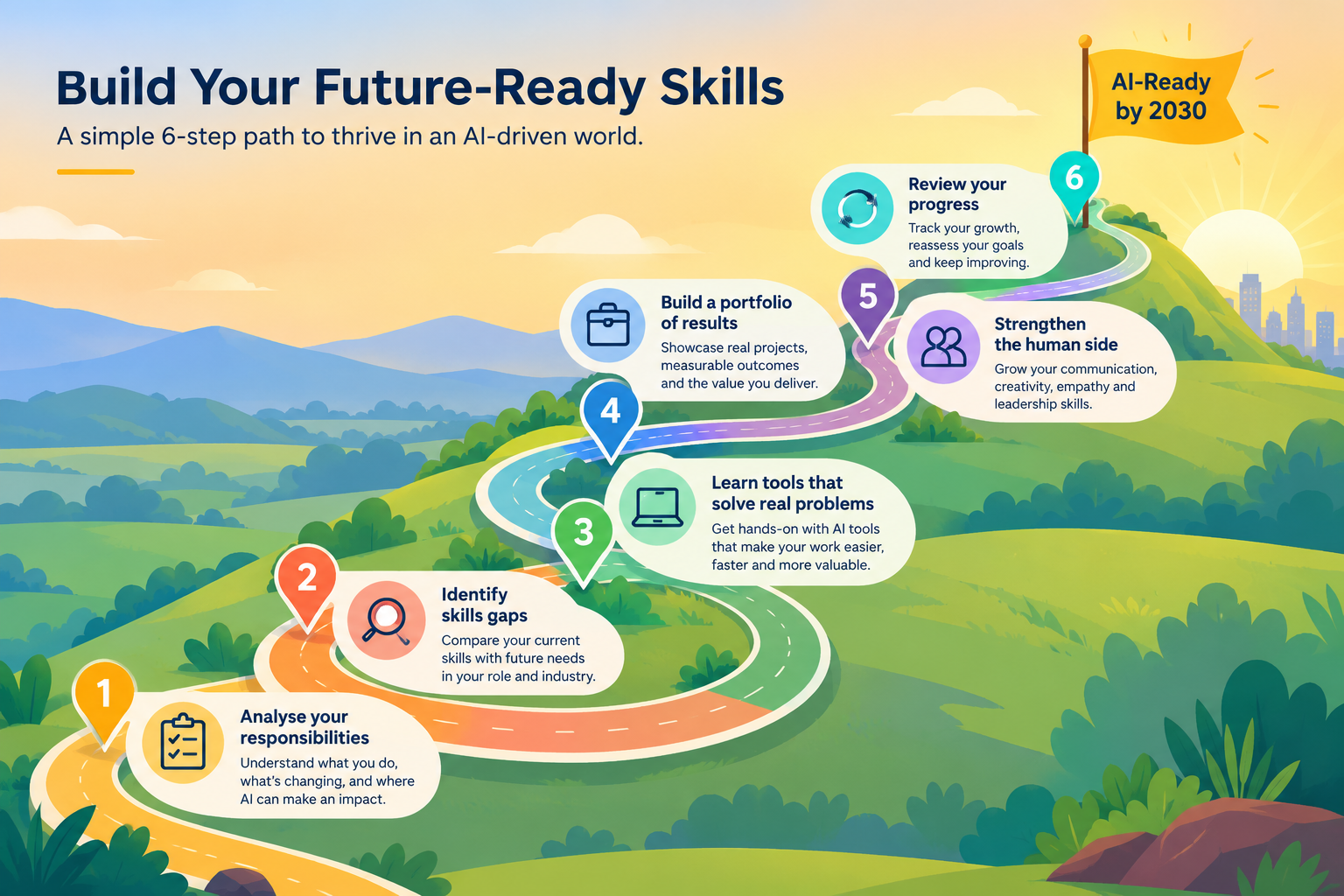
Carefully analyse your current job responsibilities
List your current job responsibilities and analyze if they are repetitive, analytical, interpersonal, creative or physical. Identify which tasks require AI assistance and which ones require major human judgment.
Identify the skills gap
Evaluate if your current skills match the requirements of more advanced roles in your field. Carefully review job descriptions, what employers expect from potential candidates, and standards to identify specific gaps.
Learn tools that solve real problems
Identify necessary AI and automation tools you must learn to stay relevant at your work. It doesn’t mean learning all the AI tools. Just use those absolutely relevant in your job. Use them safely, check that their answers are correct, and make them a regular part of how you get things done.
Build a portfolio of practical results
Make a note of how you use AI to do things better, reduce repetitive work, understand facts, or fix a business problem. Measure the outcomes and be honest about how much work you have done yourself.
Strengthen the human side of your profession
This involves learning how to talk, work, and make good choices with others or build decision-making skills. Look for projects where you can lead a team, solve complex problems, or interact directly with clients and stakeholders.
Review your progress
Time to time, reassess what you do, the tools you use, and what you want to be when you grow up. Instead of making decisions based solely on the news or guesswork, look for real proof of what skills companies are actually seeking in potential candidates.
Read Also: Agentic AI vs Generative AI
Should You Change Your Career Because of AI?
Job-holders often ask themselves whether they should change their current employment, in the context of observing the potential risk of AI replacing most jobs. When India-based Paytm fired 1,000 employees (in 2023) because of rationalising its business through AI powered automation, the speculation that AI is set to replace jobs once dominated by human workers grew stronger.
However, a career move should be based on your job responsibilities that you perform, opportunities you come across and skill adaptation. If you think that most of what you do can be replaced or automated by AI, upgrade your skills. One more thing, even though there is a strong likelihood that jobs involving repetitive tasks can be replaced by AI, the role of human intervention will remain irreplaceable.
Conclusion
AI is likely to automate, or reshape most jobs, and change how businesses organise their teams. Jobs like data entry, clerical administration, routine customer support, basic bookkeeping and content production are at a greater risk of being replaced by AI.
However, it is also true that predictions about job loss due to AI should not be confused with 100% certainty. Just because a job is exposed to AI doesn’t mean it is redundant. A job can remain vital even when most of its tasks become automated.
If you are concerned about future jobs being replaced by AI, the most practical strategy for you is to combine the knowledge of AI with critical thinking, communication, data skills and specialised knowledge. If you build the ability to verify AI outputs, solve unknown problems and apply professional judgment, you become useful as job requirements evolve.
You will end up wasting your time if you compete with AI at every job. That should not be the goal. Instead, develop the skills needed to use AI effectively, identify its limitations, and take ownership of the work that matters.

The EIMT Editorial Team is made up of academic editors, faculty contributors, curriculum specialists, instructional designers, education researchers, programme managers, quality assurance professionals, content strategists, and subject matter experts...
Latest Updates & Articles
Stay Connected !! To check out what is happening at EIMT read our latest blogs and articles.


Sep 10, 2026

Sep 10, 2026