

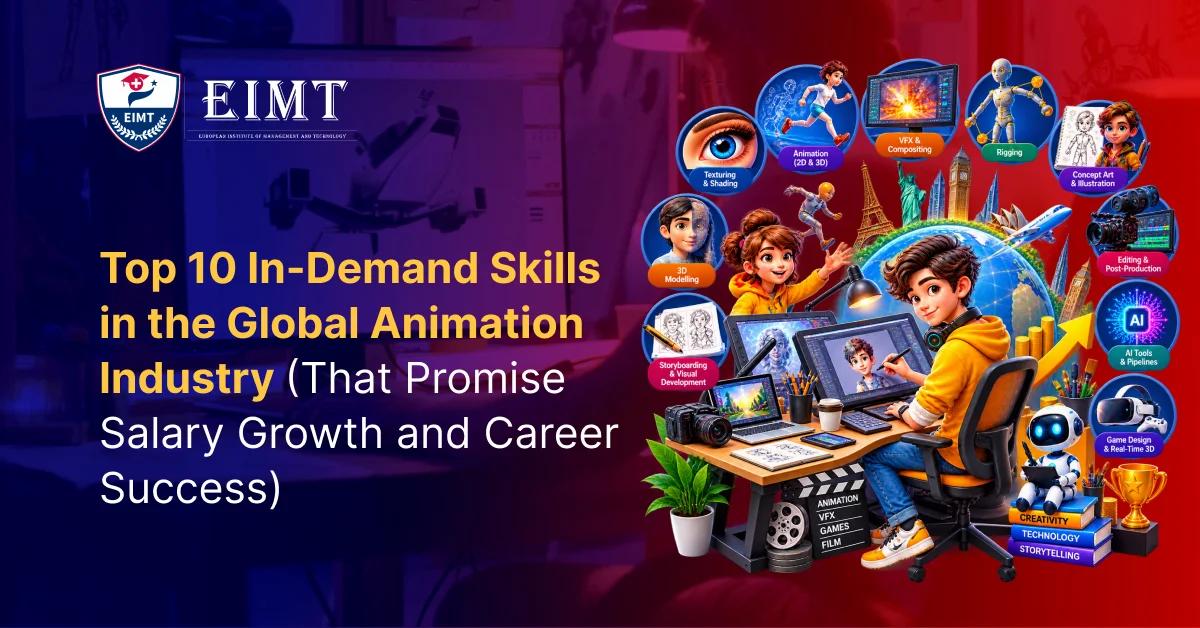
Top 10 In-Demand Skills in the Global Animation Industry (That Promise Salary Growth and Career Success)
Home / Top 10 In-Demand Skills in the Global Animation Industry (That Promise Salary Growth and Career Success)
Animation and Design
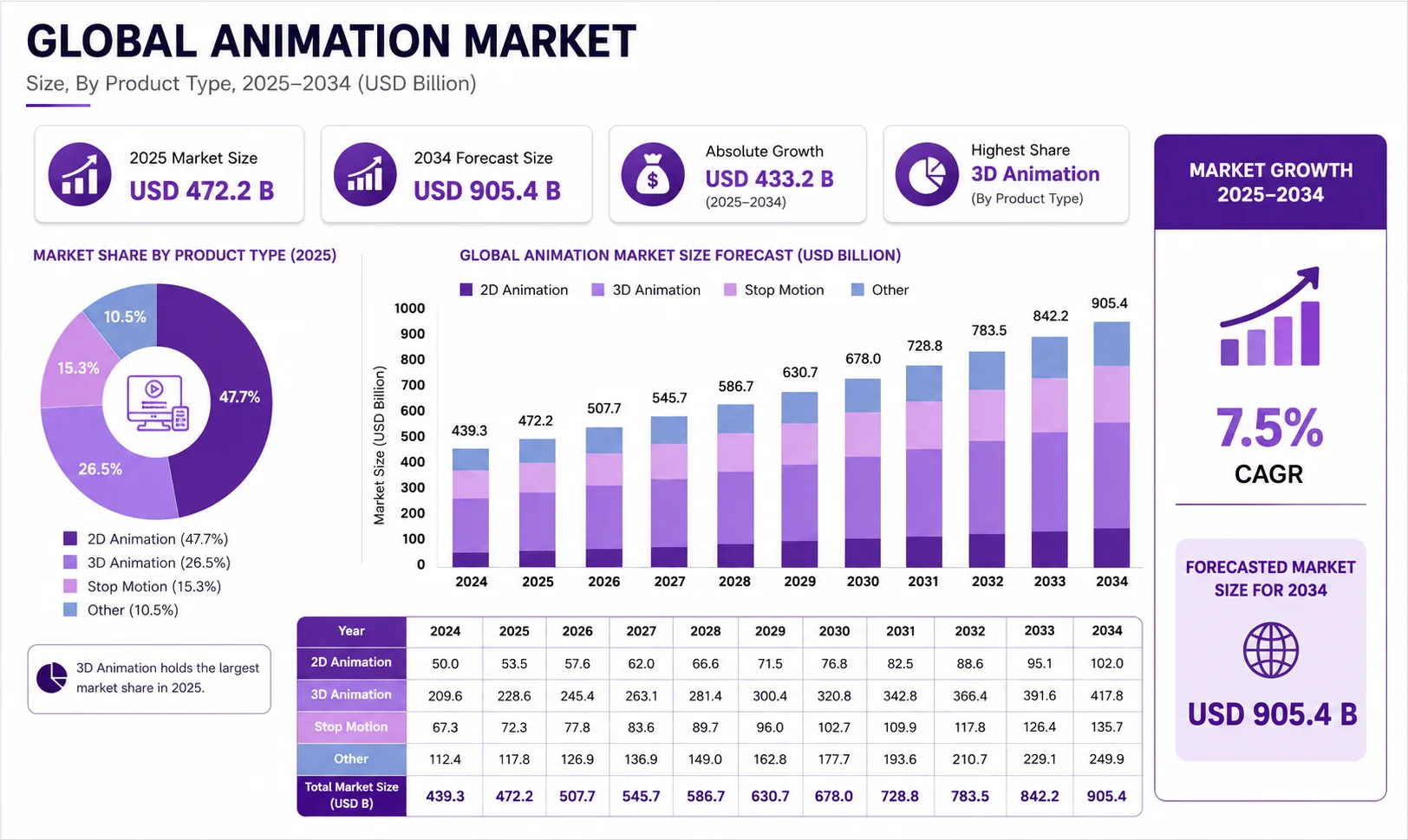
The animation industry is growing at a rapid scale. According to a Yahoo Finance report, the global animation market size is expected to reach nearly $953.31 billion by 2035 from its current growth figure of $492.14 billion in 2026. The growth is attributed to the factor of how animated content across media, gaming, education, and manufacturing sectors is rapidly adopted.
What drives the animation industry - Key market takeaways
- Based on the product type, 3D animation is taking the lead with 45.2%, largely due to high demand in movies, gaming, advertising, and immersive media, shaping the future of animation.
- Industry-wise growth in animation indicates a trend where media and entertainment will rule the roost with 30.5%, driven by the industry's growing dependence on animation for content creation and visual storytelling, making it a key part of the future animation industry.
- North America's contribution to animation industry growth is 35.1% due to the push from strong production studios, technological innovation, and streaming platforms.
- The market of generative AI in animation is growing rapidly from $1.3 billion in 2003 to an estimated climb of $28.1 billion by 2033 followed by increasing demand for automation in animation design and production value.
What does the global animation market indicate for your career in the sector?
The speedy growth of the global animation market indicates that the industry is no longer about drawing frames or building 3D models. It is rather moving at a quick pace as a technology-driven field shaped by different contributory factors such as gaming, streaming platforms, virtual reality, and artificial intelligence.
Therefore, studios are seeking to hire skilled professionals who can bring artistic talent together with technical fluency and adapt as fast as the tools themselves evolve. The growth is also indicative of some major changes in countries like America.
According to the U.S. Bureau of Labor Statistics, there will be about 5,000 job openings each year, on average, for special effects artists and animators over the 2024-34 decade, despite the overall employment growth in the country being projected at 2%.
Hence, for your career in the animation sector, the global growth trend of the animation industry simply means building a positive career pathway with higher earning potential.
This guide will help you familiarize yourself with 10 skills these studios are actively looking for and why each one matters for an aspiring animator, career-changer, or a working professional.
Top 10 in-demand skills in the animation industry that promise higher salary growth and career success
01. 3D modeling and animation
3D remains an integral part of the animation industry presence of which we can observe in animated movies, AAA video games, or in production visualisation for advertising. Therefore, the ability to build and animate believable 3D characters and environments is at least a foundational requirement for career aspirants.
Moreover, if you take a look at current industry data, it shows that a professional who specialises in 3D modeling and visual effects is bound to see career success, in light of how these skills are demanded in gaming and film production.
Why does it promise higher salary growth and career success?
3D modeling and animation promises higher salary growth and career success in view of rising demand for digital content across gaming, movies, advertising, and virtual reality. Earning potentials of skilled professionals are higher as studios are locked in competition with rivals to build realistic visual worlds.
Besides, a very skilled 3D artist can make a career transition between film, games, VR (virtual reality), and advertising without having to upskill from the scratch, except the software pipeline changes.
Key Highlights:
- Higher earning potentials for experienced artists in top studios.
- Quick career growth as a lead artist or director for skilled professionals.
- Remote work opportunities in most global jobs.
- Work with global clients.
- Skills to learn - Mastery in tools like Maya, Blender, ZBrush, Cinema 4D, and others including anatomy, lighting, and physics.
02. Character Rigging
Some may argue that rigging is not a glamorous skill, but it is still essential for making animation possible. You see, an expert in character rigging builds the digital skeleton and controls the system allowing animators to pose and move a character that seems real.
The point is, without a well-built rig, you can't move easily even the most beautifully modeled character, and chance is that it may break under complex motion.
Why does it promise higher salary growth and career success?
Character rigging is promising higher salary growth and career success based on how production houses worldwide are pushing for a more nuanced facial performance, cloth simulation, and creature movement.
This means technically skilled professionals or riggers will have a higher demand in these fields, and also because skills riggers are in short supply. Since character rigging in animation bridges the gap between art and engineering, it is essential for a rigger to understand both anatomy and scripting logic, which makes it a harder skill that automation can’t replace.
- Higher earning potentials for skilled riggers in sectors involving giving emotional movements to 3D models, digital avatar or virtual puppets.
- Better job stability as skilled riggers are needed in almost every film, game, and TV show.
- Career transitions for skilled riggers into technical directors or production pipeline leads.
- Skills to learn - Autodesk Maya, Blender, Inverse Kinematics, Forward Kinematics, node-based logic, etc.
03. Motion Graphics Design
Is motion graphics design a good career move?
If you come across questions like that, the answer is, yes. It is one of the most sought-after skills in the animation industry, largely due to the demand pushed by continuous explosion of short-form video content, digital ads, and the growth of streaming platforms like social media, corporate and educational content.
The demand of short-form video animated content that looks polished and communicates quickly for brands, marketers and media companies has given rise to the demand of skilled motion graphics designers.
The designers fluent in After Effects, Cinema 4D, etc. have huge demands in modern animation studios to facilitate the creation of fintech explainer videos, SaaS product demos, and branded social media content.
Why does it promise salary growth and career success?
Motion Graphics Design promises higher salary growth and career success, given how businesses around the world are leaning more on video content for marketing, entertainment, and digital communication across social platforms.
Top industry players are seeking skilled motion graphics designers to pave the path for creating engaging visual content for an effective brand promotion and competitive edge. Since the video content rules the internet today, experts in motion graphics design undoubtedly have strong growth potentials in the fields like motion ads, UI and app animations, digital visual effects, etc.
- Better career growth in lead roles managing big creative projects
- Career success perks include remote work opportunities, creative freedom to build your unique style, never get stuck in one specific job, and fast promotions by proven visual results.
- Skills to learn - Typography, layout and composition, color theory, visual hierarchy, animation fundamentals including easing, timing and spacing, technical skills including Adobe After Effects, illustrators, Photoshop, and video editing.
04. Storyboarding and visual storytelling
Storyboarding is more like a visual blueprint of production or projects, allowing directors and creative teams to determine framing camera movement, character positions, action and pacing.
A skilled storyboard artist must think like an illustrator and director, understanding shot composition, perspective, continuity, camera language and organising a way to build and tell a story. On the other hand, visual storytelling is important in the context of using images, videos, graphics, and design to communicate a clear message to the audience.
Why does it promise salary growth and career success?
Both storyboarding and visual storytelling drive salary growth and career success for skilled professionals in these fields who know how to transform complex ideas into clear, engaging concepts. They are high-demand skills boosting values across tech, film and marketing, often leading to lucrative career pathways.
- Career paths as UX/UI designers, pre-visualisation artists, and creative directors.
- Very sought-after in top industries where creating engaging visual content is a priority for competitive edge among brands.
- Higher salary growth in big companies or product launches.
- Skills to learn - Thumbnail sketching, cinematic framing, pacing and rhythm, character performance, script interpretation, etc.
05. Lighting and Rendering
Lighting and rendering both are skills in 3D animation that combines artistic cinematography with technical optimisation. Lighting is one of the most powerful storytelling tools that establishes mood, direct attention, communicates time of day and influences how audiences perceive a character or environment.
Lighting artists use virtual light and shadow to build mood, guide the viewer's eye, and define shapes. Rendering, on the other hand, is the eventual computer process that turns 3D models, textures, lighting, and camera movements into a sequence of 2D images or a video file. Rendering skills involve calculating physics and software settings to turn 3D scenes into clean, final 2D image sequences.
Why does it promise salary growth and career success?
Lighting and rendering skills promise salary growth and career success in animation, gaming and VFX sectors where visual quality of a project matters. Experienced professionals make themselves valuable in these fields and lead to senior roles as well.
The lighting and rendering skills matter as studios need artists who can bring life to scenes, making them look lifelike and stunning.
- Job roles as a senior lighting artist, technical director, and visual effects supervisor.
- Work from home opportunities in studios worldwide hiring skilled remote talent.
- Skills to learn - master color theory, physical light behavior, rendering engines like V-Ray, Arnold, node-based compositing. Scene optimisation, look development, etc.
06. AI-assisted animation and prompt craft
AI-assisted animation has been going through rapid growth over the last two years since the adoption of AI tools across the production pipeline. In fact, intelligent technology has been transforming the animation industry by accelerating technical workflows and automating repetitive tasks in video generation.
Though fear of job displacement and copyright infringement is also rife in the industry, there is no denying the fact that smart AI tools are empowering human artistic expressions.
Studios like DNEG, specialised AI platforms like LAYER, and gaming developers like Round 8 Studios routinely hire artists to direct, prompt, and refine generative AI outputs.
Artists are also in demand who can direct and refine AI-generated outputs using generative tools for background creation, quick ideation, in-betweening and pre-visualisation without ruling out human judgment for timing, emotion and storytelling.
Why does it promise salary growth and career success?
AI-assisted animation is an essential skill, enabling you to create moving graphics and cartoons, handle tasks like filling in frames, or matching lip movements.
On the other hand, prompt craft is writing the precise text instructions to guide AI tools into producing the exact content.
Therefore, combining the skills proves a career accelerator for skilled professionals in job roles, where humans lead the creative direction and storytelling while software heavy production work.
- Growth opportunities expanding across entertainment, advertising and tech.
- Growth in job roles like AI pipeline engineers, creative AI supervisors, multimodal prompt specialists.
- Be a part of high growth industries like gaming and immersive media, marketing agencies, enterprise software and EdTech.
- Skills to learn - Build rigorous testing and evaluation suites for model outputs, master timing, emotion, and storytelling principles.
07. Visual effects (VFX) and compositing
VFX artists are some of the most sought-after specialists in the animation industry, especially in sectors where streaming platforms and blockbuster films require increasingly complex effects work.
In fact, VFX and compositing skills are extremely valuable for tasks related to photorealistic creature work, environment extensions, or seamless integration of animated elements into live-action footage.
Clarification - Please note that VFX has its own distinct sector within the broader entertainment industry. The reason for its inclusion here is skill overlap and career crossover with animation.
Why does it promise salary growth and career success?
Considering this is a technically demanding career path, it requires proficiency in tools like Nuke, Houdini, and After Effects, alongside a strong understanding of lighting, color science and camera tracking. In terms of salary and career growth, the field promises exceptionally, with VFX and game design roles showing more pronounced salary rise.
- Higher salary growth globally driven by strong demand from films, OTT streaming, and gaming.
- Job growth from junior clean-up or roto artist to specialized technical director (TD) or VFX supervisor.
- Career growth for compositing experts from junior compositor to mid-to senior level compositor, VFX supervisor, etc.
- Skills to learn - A mix of artistic and technical skills, core node-based or layer-based compositing, camera tracking, rotoscoping, green-screen keying, and color matching.
08. Technical Direction and Pipeline Scripting
Technical directors who can script custom tools (often in Python) are sought-after resources for the productions and studios that prioritize automation. These experts act as a bridge between software packages, automate repetitive tasks and keep large production pipelines up and running across dozens or hundreds of artists.
Studios require people who understand both the artistic workflow and the inherent software architecture well enough to solve bottlenecks like slow software, tech limits, etc.
This means, technical directors with scripting ability are suitable for the jobs for building customer integrations that allow AI features to work easily along with existing production tools.
Why does it promise salary growth and career success?
Technical direction and pipeline scripting promise salary and career growth by bridging creative art and software engineering. Therefore, if you are skilled in automating workflows, building tools and solving studio bottlenecks, you are in for higher salary growth, also commanding leadership pathways eventually.
- Great opportunities in studios looking for professionals fluent in both Python and software like Maya.
- The skill brings forth automation value, meaning saving hours of manual artist labor to increase production efficiency.
- Skills to learn - master data flow, pipeline architecture, modern tool integration, etc.
09. Virtual and Augmented Reality Production
We are witnessing how immersive media is getting stronger than its early hype cycle. Animators who are skilled in designing for VR and VR are bound to experience growth opportunities in gaming, training simulations, live events and experiential marketing.
Why does it promise salary growth and career success?
Experienced professionals in virtual reality and gaming will receive higher salary growth because of increasing industry needs. And there is no stopping of this trend as long as immersive hardware becomes more mainstream.
In addition, augmented and virtual reality (AR/VR) production promises salary growth and career success by creating high demand for specialised technical skills across sectors like healthcare, retail, and defense.
As an expert, you will get high compensation and this is due to the fact that just a few workers possess expertise in 3D engines, spatial computing, and immersive design.
- Entry career roles start strong, with senior professionals earning top-tier tech wages.
- Be a part of companies using immersive simulations for complex technical training.
- Skilled professionals in Bender or Maya become AR/VR designers. Other career roles include spatial computing specialists.
- Skills to learn - Master Unity or Unreal Engine, learn C# for Unity or C++ for Unreal Engine to code logic, user input, and physics, learn skills in 3D modeling, texturing and materials, etc.
10. Communication, collaboration, and adaptability
If you wonder why there is no skill mentioned in this section, it is intentional. This is because the last section of this writing is not featuring a skill or technical specialisation, but it is the ability to work effectively with other people. And this is essential!
Animation is mostly collaborative, meaning it often involves talent pool including;
- Directors
- Producers
- Storyboard artists
- Modellers
- Riggers
- Animators
- Lighting artists
- Compositors
- Sound designers
- Programmers
Hence, it is important for an animator to understand feedback, communicate ideas, meet deadlines and adapt when creative decisions change. It has been observed that communication, leadership and people skills and collaboration rank among the most important skills in AI-related job roles.
Why does it promise salary growth and career success?
Communication, collaboration and adaptability promise salary growth and career success because they are the skills even more valuable in AI-related job roles. They were valuable long before AI became mainstream in jobs.
Since animation is teamwork, you can’t overlook these skills, because they are directly related to influencing a project’s quality of work.
- Drives career growth in leadership, builds team synergy
- Allows learning new tools and workflows with ease
- Effective crisis management
- Ensures your career remains valuable and relevant as markets evolve
- Skills to learn - active listening, empathy, clarity in communication.
Winding up
The animation industry is no longer tied to its mainstream era defined by a single production method. It is going through significant phases as highlighted in the write-up. In fact, we observe an overlap concerning traditional animation, 3D graphics, VFX, gaming, real-time rendering, virtual production and AI-assisted workflows.
Listed in the write-up includes 10 in-demand skills in the global animation industry that promise higher salary growth and career success. Each represents its own distinctive capability of influencing your career transition. Choose the one best suited to your career goal.
The EIMT Editorial Team is made up of academic editors, faculty contributors, curriculum specialists, instructional designers, education researchers, programme managers, quality assurance professionals, content strategists, and subject matter experts...
Latest Updates & Articles
Stay Connected !! To check out what is happening at EIMT read our latest blogs and articles.

Sep 10, 2026
Sep 10, 2026