
How Artificial Intelligence Is Transforming Animation and Digital Creativity
Home / How Artificial Intelligence Is Transforming Animation and Digital Creativity
Animation and Design
When Bryn Mooser, the co-founder of Moonvalley, said that AI in Hollywood is inevitable, that was one of the signs of how AI is playing the changing power player, not only in the film industry but also animation and digital creative fields.
Some believe that AI-assisted animated films or the entry of intelligent machines into animation is a major breakthrough, whether AI will be the future of cinema is still up for debate.
Well, in the context of this writing, at least I tend to believe that AI is transforming animation and digital creativity in more ways than we can imagine, starting from how it has democratized the creative scale of animators.
What exactly is the role of AI in animation and digital creativity?
There was a time when animation was a craft measured in manpower and timelines involving armies of artists working tirelessly over frame after frame, trying to make characters lifelike one pixel at a time.
That day is now long gone because of the creative force of artificial intelligence. Now, that kind of magic is now redefined by intelligent algorithms that can sketch, animate, and even do the imagining in seconds.
Today, an animated masterpiece can be created using a simple sentence typed into a video-generating AI tool. In addition, the entry of AI into animation studios is a key indication of how creativity is being rewired, from what used to be a labor-intensive craft built on storyboards, sketches, keyframes, 3D modelling and rendering, and countless hours of manual refinement.
AI is changing the creative workflow from the ground up, generating visual concepts, animating characters, assisting with modern capture, creating environments, improving visual effects, and animating scenes.
What sets the bottom line of this argument is not that AI can now generate images and animation but it is transforming how inventive ideas shift from imagination to execution.
Is AI transforming animation and digital creativity by eliminating the need for real artists?
AI-led transformation in animation and digital creativity is or should not be seen as a factor to eliminate the need for real artists, as it is technically impossible. You can't rule out human intervention in every bit of creativity workflow.
The job of artists remains significant and unavoidable. For example, AI tools for creating animated videos or performing digital creative works require human supervision, or are controlled by human artists who know what prompts or maneuvering would produce the best result from a machine.
AI is at its creative best as long as there is human-assisted observance in play. The role of AI in animation and digital creativity actually makes sense when you assign it to do creative tasks that manually would take lots of time.
Automating repetitive technical tasks and taking control of creative decisions in your hands is the kind of AI-human collaboration transforming animation and digital creativity in the future.
How animation in old ways was slow
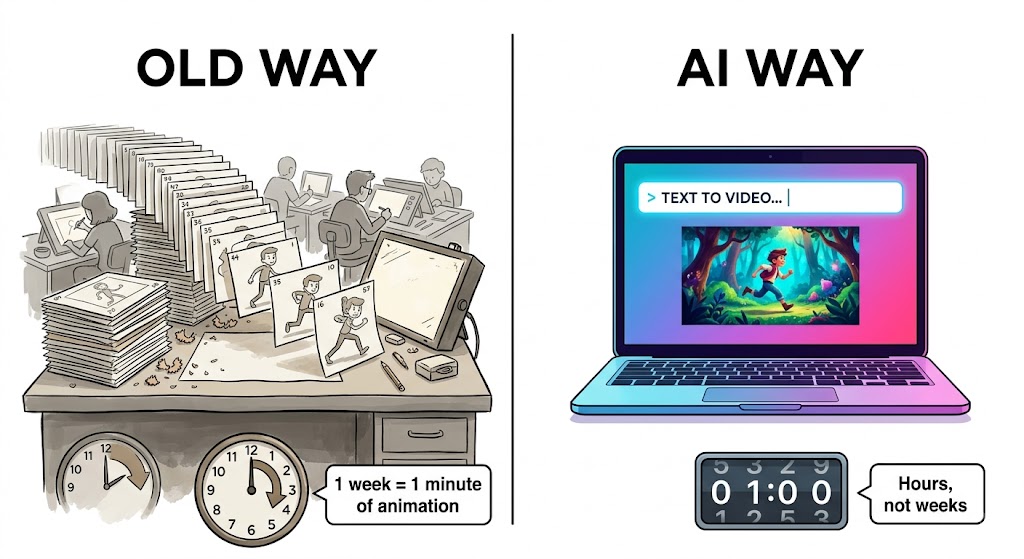
Earlier, animation used to work by involving a team of illustrators to draw thousands of individual frames, each one different from the last, to create the illusion of movement.
Interestingly, even though digital tools started to gather mainstream popularity in the 1990s and 2000s, the advancement did not rule out the labor-intensive work associated with the fundamental workflow in animation.
Tasks like storyboarding, rigging, keyframing, and endless rounds of revision remained time-consuming. A skilled artist had to spend a week or more time to create a single minute of high-quality 2D animation.
Though big studios came up with the idea of solving this with scale by deploying hundreds of animators working in parallel, the problem for smaller creators, independent filmmakers, and solo YouTubers remained unsolved.
It is also worth noting that animation is different from other art forms. It is comparatively slower and more time-consuming. The sheer load of mental work involved in animation can be understood with the fact that it takes animators years of experience to create professional-quality work.
In addition, the old method for creating an animated film involved hiring a large team of experienced animators over several years to produce a full-length film, which typically cost $150 million or more.
Obviously, the advent of AI is quite a breakthrough because it broke the bottleneck defined by human hours in executing creative tasks in the animation world.
Top reasons AI is Transforming Animation and Digital Creativity
The use of AI is pervasive in almost every stage of animation today for tasks like generating new ideas, improving motion, fixing video issues, reducing rendering time, cleaning up frames, and even assisting in editing.
If handled manually, final completion of these tasks becomes more tedious and time-consuming for a real artist, thus accentuating the value of AI tools in streamlining tasks for creating animated videos. Here are top reasons that place high importance of AI in animation and digital creativity.
AI is democratizing creativity
For me, the most unique benefit of AI has been the way it has democratized creativity, ensuing the rise of solo creators. Aside from the most profound effects AI has rendered in the world of animation, it also caused economic and cultural impacts, as even a single person with a laptop can produce an impressive animation that once required a studio.
And this is why we see a growing number of creators on platforms like YouTube, TikTok, and game development communities.
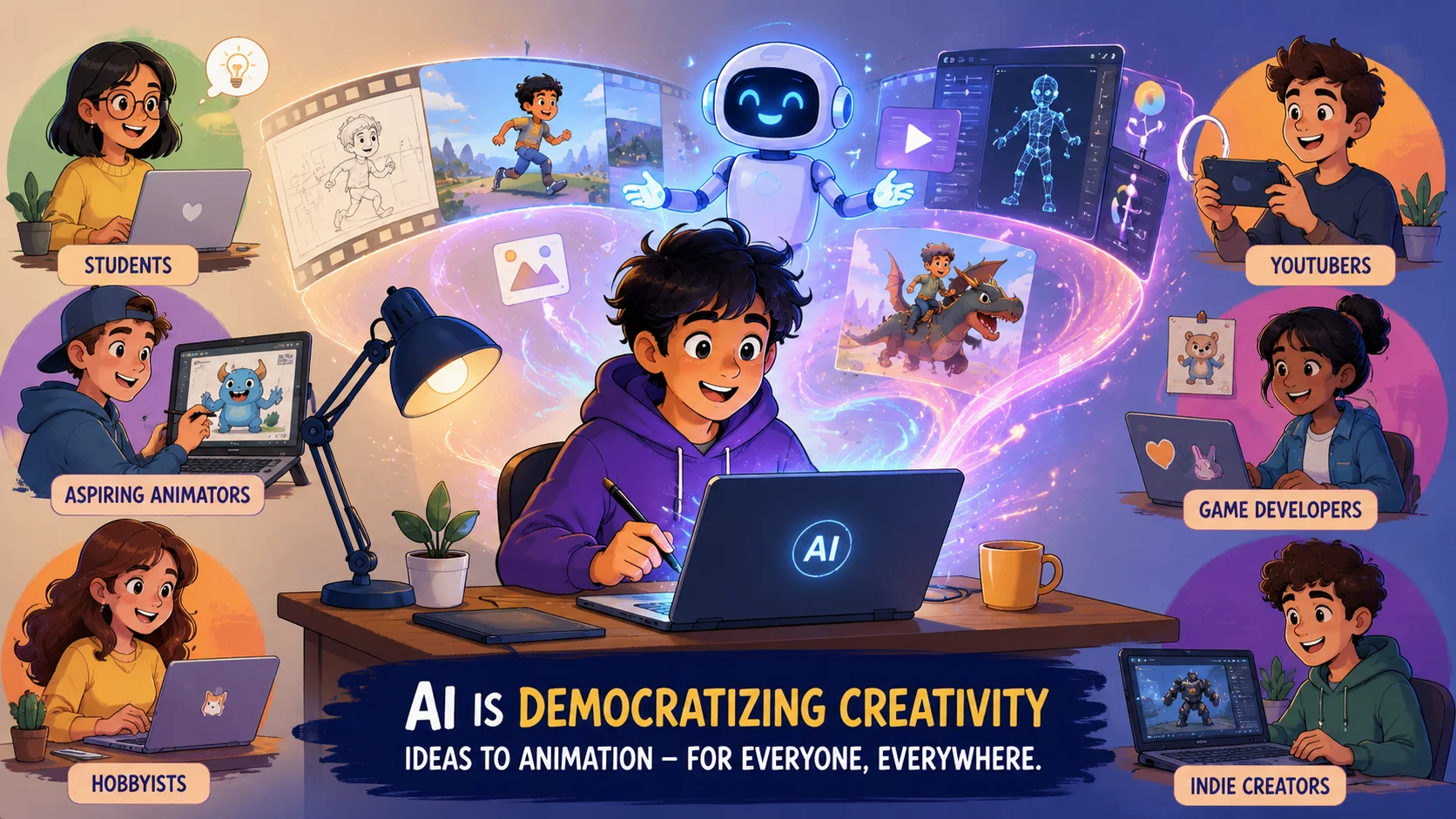
Solo creators are now generating animated shorts, explainer videos, and even episode series valued by professional production houses. As far as labor-intensive groundwork in animation is concerned, AI handles smartly in terms of voice synthesis, background creation, lip-syncing, color correction, etc.
Imagine the amount of pressure and time it saves for individual creators. With creativity now being democratized due to AI, we see the perceptible impact of the same in music production where affordable digital audio workstations have replaced expensive studios.
Take the example of photography where the camera of a smartphone is making every creator's dream of generating cinematic shots true. Obviously, AI has impacted the creative field that is pervasive and is felt more productive.
AI is now a smart assistant transforming creativity
The role of AI as an animator's assistant is something more of a creative booster, where the intelligent machine is handling tedious, repetitive tasks of animation, including automating in-between frames, which once were quite a herculean task.
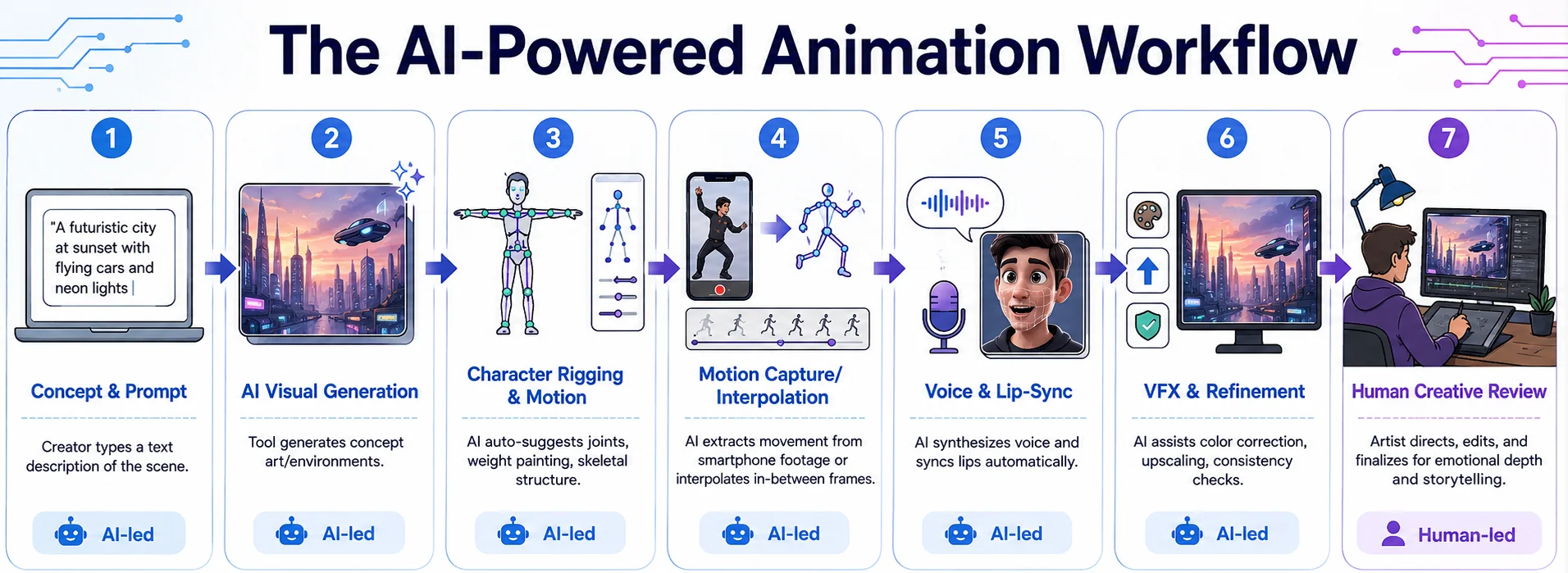
The work of an AI model in interpolating the motion picture smartly instead of requiring an artist to draw every frame between two key poses is what explains one of the positive upside of AI transforming animation tasks.
The reason I am making this statement is based on the intelligence of the technology in understanding not just the pixel differences in interpolating the motion but also the way it understands the underlying physics and anatomy of the movement. This is an incredible talent of technology.
In animation, AI is also capable of rigging characters for movement by analyzing a 2D or 3D character model and suggesting joint placements, weight painting, and skeletal structures, thus cutting down setup time from days to hours.
In addition, AI is transforming motion capture. AI-powered pose estimation can now extract animation data from ordinary video footage. As a result, a creator can film themselves using a smartphone and the AI software will decode and translate that act straight onto a digital character.
The age of generative animation and text-to-video revolution
I don't think anyone would have imagined creating video footage just by typing a prompt to an AI model. An animated video that was once a labor-intensive task and took days to complete can now be created using a simple prompt to a video generating AI tool.
This is where the ability of AI feels infinite, creating an entire video and animation sequences from nothing more than a text prompt. All you need to do is to type a description of your priority video in terms of color, scene and other details and the tool will create short animated clips perfected with camera movement, lighting, and stylistic choices.
Does that mean AI has perfected the art of animation?
Well, AI has not perfected the art of animation, considering some issues, including pipeline friction, lack of emotional depth, and over-smoothed aesthetics are there. Since technology is evolving, it is just a matter of time when we see truly amazing, lifelike and brilliant creativity in AI-assisted animated videos.
However, the direction of AI to transform animation and digital creativity is unmistakable. What once was considered dreamlike is now locked into tools capable of producing clear, stylistically controlled animation.
AI in visual effects and live-action integration
The influence of AI is not just limited to pure animation but extends to a broader world of visual effects. This is because of how film and television productions increase their reliance on machine learning models for tasks like de-aging actors, creating realistic crowd animations, upscaling old footage and even creating digital doubles for stunt sequences.
I know that the Hollywood industry went on strike against the unguided use of AI in tasks that directly or indirectly involved infringement of copyrighted materials, but that is not the point in this narration.
AI is being incredibly helpful and transformative in visual effects. For example, voice synthesis technology now is used by studios to generate dialogue in an actor's voice for looping, translation or even posthumous performances. Well, this surely raises some ethical concerns, and this is where proper guardrail in place is necessary.
Smart tools that understand creative intent of your task
Some may argue that the role of AI in animation is only related to the speed with which it executes a task. While this is a fact, it doesn’t characterise the whole picture of the power the intelligent technology possesses.
In fact, it is beyond a speed upgrade in animation and more of a qualitative work, especially the way it understands creative intent of the task rather than executing it mechanically.
Today, the intelligent AI-assisted design software tools understand the creative intent behind a task and accordingly suggest color palettes based on the emotional tone of a scene. These tools, depending on the task priority, can also recommend camera angles matching cinematic conventions, or flag inconsistencies in character across frames.
Let me tell you a very basic yet useful detail about artificial intelligence in the creative field. When using a video editor, its inbuilt AI assistant instantly flagged character inconsistencies in my video. It suggested changes, and also synced the missing elements I failed to notice in the first place. For someone who was new to this creative field, those suggestions meant a lot.
AI-assisted software tools are aplenty that can suggest you a rough sketch and different stylistic directions, thus acting more like a collaborative creative partner in your animation task.
Some may believe that this is quite an intrusion of AI into the creative field once dominated by humans. I think this is more like having an intelligent tool taking care of tasks that are more labor-intensive so that you can focus on creative purity of the output.
Basically, even though AI tools are getting advanced, human intervention is not at all ruled out.
AI is making digital creativity more experimental
One of the most interesting impacts of AI is experimentation, other than efficiency. If you are a digital creator, with AI, you don't have to possess advanced technical skills just to test an idea.
You can now explore an animation concept, visualize a character and create an animated product sequence. A social media creator, for instance, can transform a static illustration into a short video.
Therefore, the side of AI in the context of experimentation of ideas is not less than a creative marvel by allowing creators to experiment the combinations of styles, camera movements, environments and visual concepts.
From this standpoint, the role of AI is more like expanding a creative sandbox.
Is AI going to take away jobs in animation and digital creativity?
The way AI is being adopted in the creative field faster is surely raising concern about whether it will pose a risk on employment of real artists. The thing is, production tasks that once needed a great deal of manual labor are becoming easier to automate, thus changing the demand for certain roles or how the production team is structured.
But it would be imprudent to predict anything for sure that AI will displace jobs.
As tasks that require repetition are being automated, professionals who are skilled in directing AI systems, analysing outputs, and can maintain visual consistency and make sophisticated creative decisions will be more sought-after.
Technically, the demand for skills is bound to take precedence over the debate who will replace who.
Therefore, the jobs in animation and digital creativity will be determined by a combination of different factors, including how much you know about AI along with possessing traditional artistic abilities, storytelling, composition, animation principles and character performance, etc.
Winding up
The future of animation and digital creativity will not be defined by the amount of work AI will create but by the amount of productivity human creators will generate with the help of artificial intelligence.
The intelligent technology is already making a positive headway in transforming animation by speeding up creative workflows, assisting with character movement, creating visual concepts and supporting visual effects.
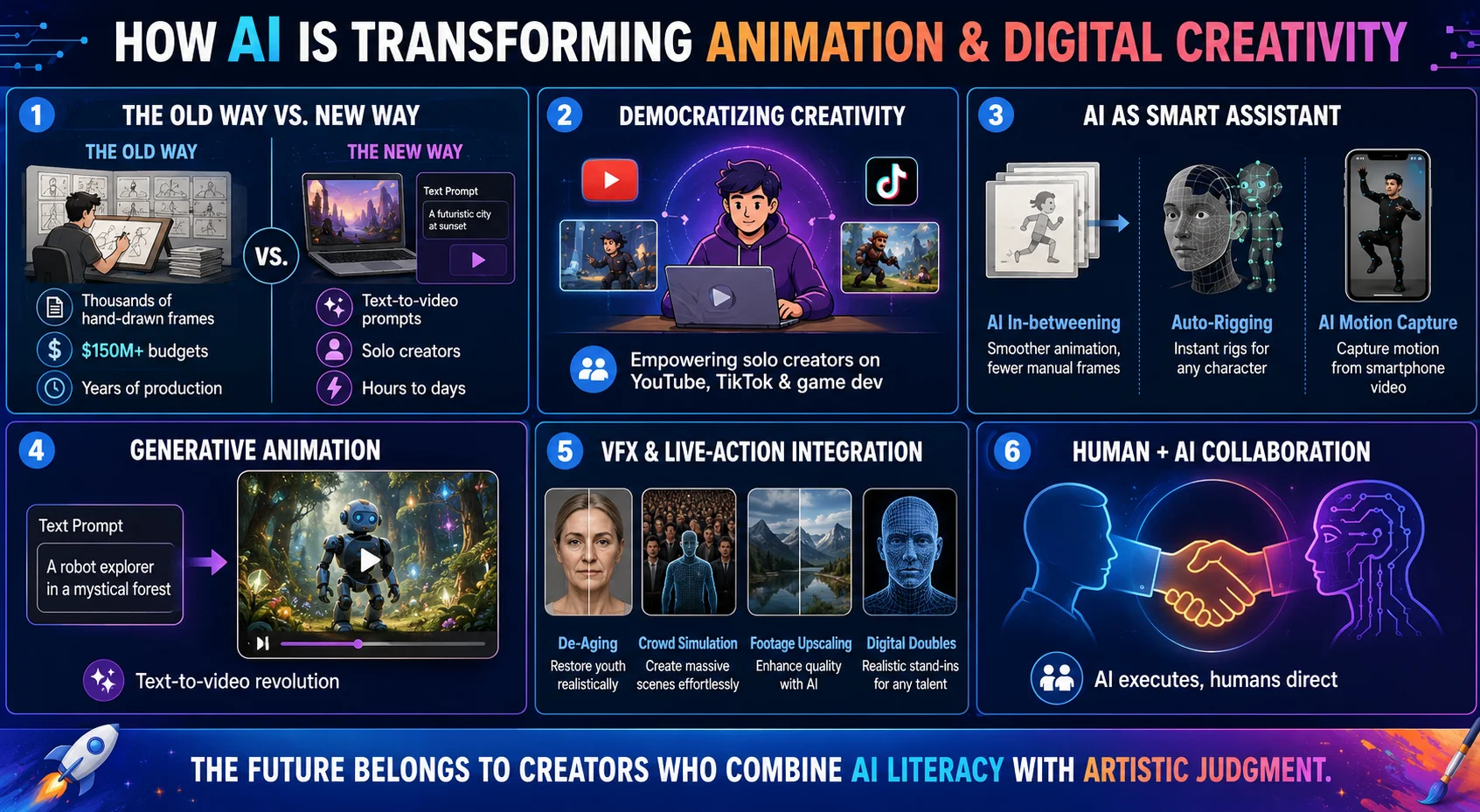
Basically, the way technology is democratising creativity is invaluable. Sophisticated AI tools from companies like Adobe and Autodesk demonstrate how AI is moving beyond simply generating images.
As far as job replacement is concerned, I don’t think AI will cause a fallout of something like that. It has not replaced a creator’s imagination, it has just given them a flexible set of brushes to experiment with creative ideas.
The smart machines are undoubtedly making the technical side of animation faster, more flexible and accessible. Under such circumstances, people who learn how to combine AI literacy with abilities like storyline, artistic judgment and originality will have the creative advantage in the future.

The EIMT Editorial Team is made up of academic editors, faculty contributors, curriculum specialists, instructional designers, education researchers, programme managers, quality assurance professionals, content strategists, and subject matter experts...
Latest Updates & Articles
Stay Connected !! To check out what is happening at EIMT read our latest blogs and articles.


Sep 10, 2026

Sep 10, 2026