


Rise of Immersive Media: VR, AR and the Future of Entertainment
Home / Rise of Immersive Media: VR, AR and the Future of Entertainment
Animation and Design
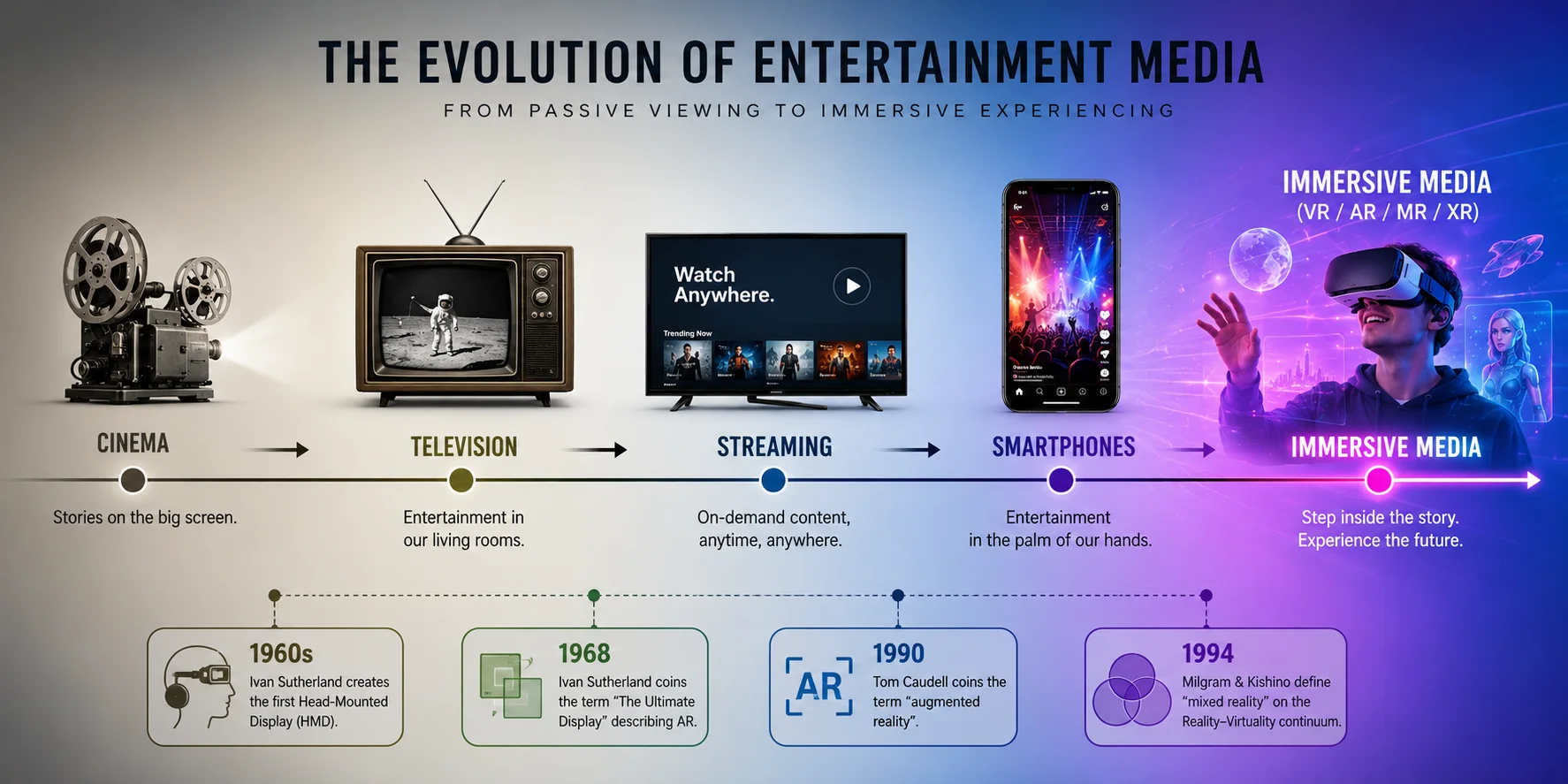
The cycle of entertainment was never static. It grew alongside the evolution of technology. For example, there was a time when cinema became an effective replacement for mass visual storytelling, and televisions brought moving images into our living rooms. Then came streaming services which made entertainment available on demand. In the meantime, technological evolution in smartphones turned screens into personal media centers.
Now, we are entering into an era of entertainment, where the screen itself is becoming less important. We call this shift an immersive entertainment where audiences not only watch a story but they can enter it, interact with it and influence based on their experiential engagement with it.
What is an Immersive Media (IM)?
Immersive media basically is the collective reference to three major concepts - virtual reality, augmented reality and mixed reality. Some may argue that the concept of immersive media is new, but the technological and psychological evolution of it have long been explored, both in the media industry and in education.
Key Types of Immersive Media:
Immersive media is more like a digital content surrounding your senses, making you feel like you are inside a virtual world or story instead of just watching a flat screen.
- Virtual Reality (VR) - It is actually a computer-generated reality simulating a real-world environment and can be interacted with real-time for an interactive and immersive experience. It first came to the surface back in the 1960s when a computer scientist named Ivan Sutherland created a head-mounted display (HMD) that could display basic wireframe graphics.
- Augmented Reality (AR) - It is basically a technological morphing of a real-world environment using superimposed data like sounds, text, and images to make it more informative through visual interactions. It first surfaced in 1968 when Ivan Sutherland built the first head-mounted display system, though the 'augmented reality' phrase was coined until 1990.
- Mixed Reality (MR) - As the name itself suggests, mixed reality is a combination of both augmented reality and virtual reality, or better say, this is where both converge. It was first introduced in 1994 by researchers Paul Milgram and Fumino Kishino in their scientific paper.
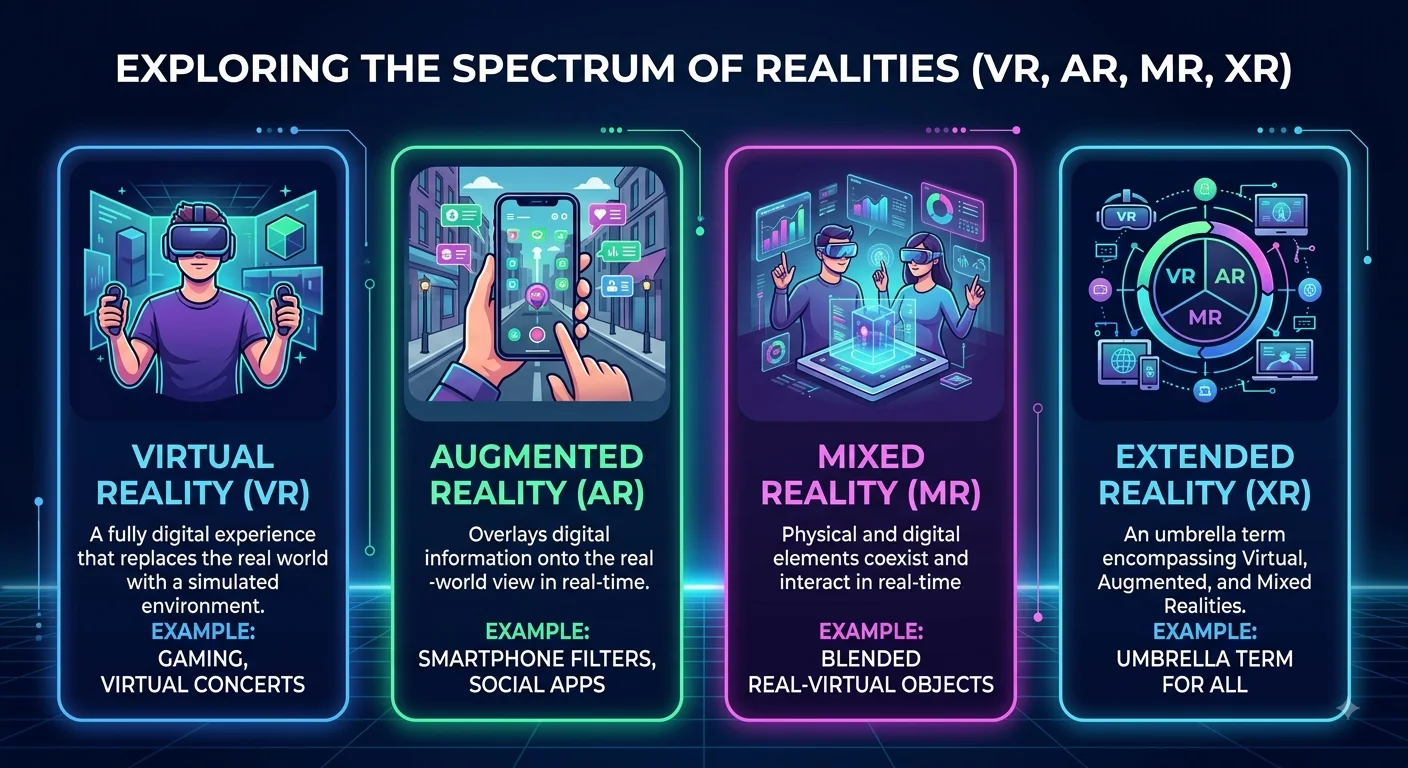
Apart from the above three, Extended Reality (XR) is also a part of immersive media. It merges AR, VR, and MR, and any other technologies that alter our perception of reality.
Why Entertainment is Shifting toward Immersion
As far as my personal standpoint is concerned, entertainment is shifting toward immersion because preferences of audiences are pushing it. Instead of watching something from a fixed camera angle, viewers find it more entertaining to experience a virtual position of it.
The way immersive media is making it easy for people to interact with digital worlds through physical interaction is what makes it turning into a mainstream favorite. In addition, I also tend to believe that the most fundamental shift toward immersion is due to the interest of people participating in the digital world of entertainment. It is interactive and at the same time, entertaining.
As an audience, wouldn't you love something entertaining being interactive, personalised and socially connected? This is what drives the shifting toward immersion, as people incline to it for a better entertainment by participating in it through physical interaction.
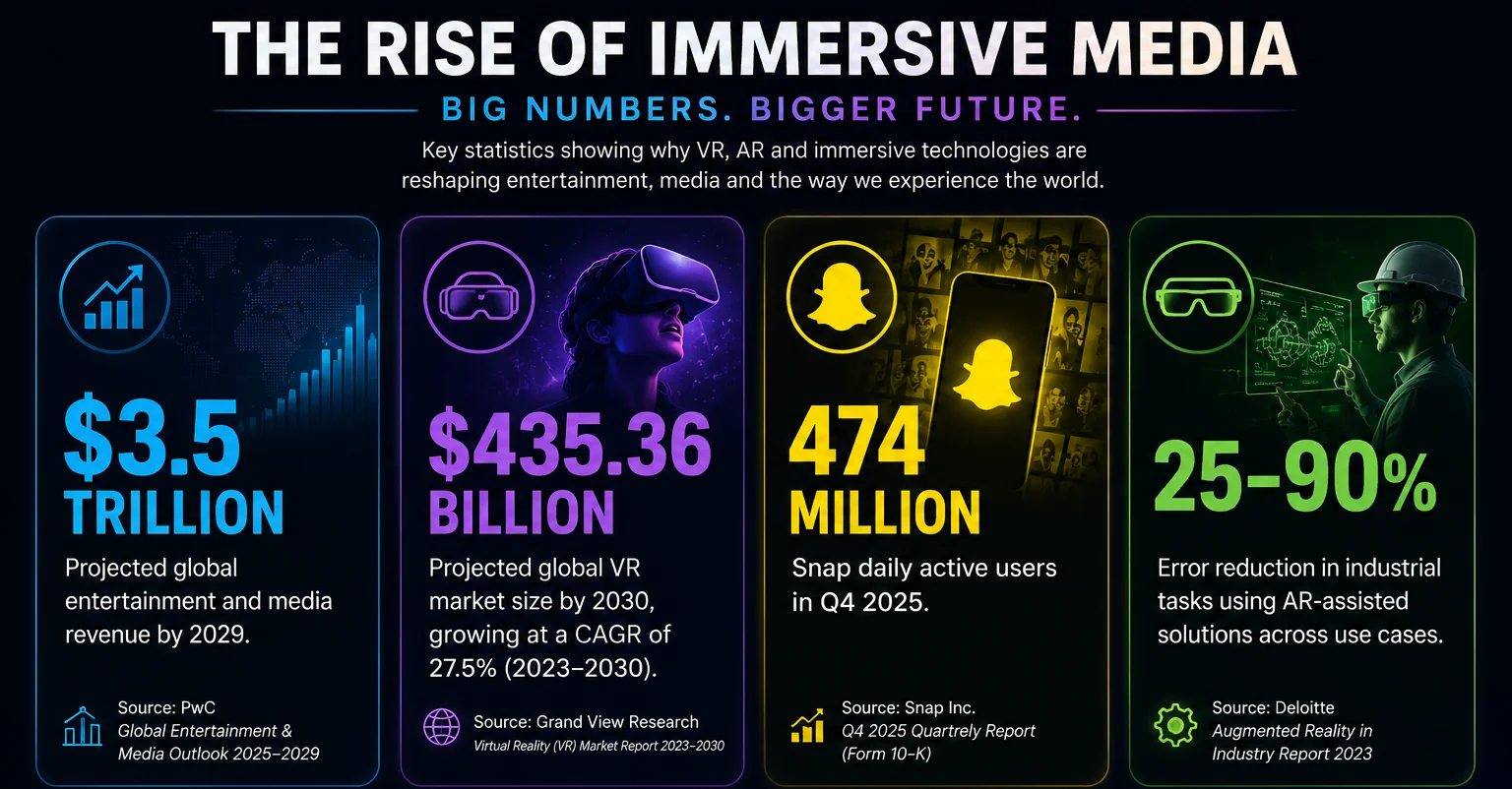
According to PwC, global entertainment and media revenue is expected to reach $3.5 trillion in 2029. This means audiences do not want passive viewing and want to change from just watching a story to physically and mentally participating in it.
What works here is a psychological craving for deep presence and multi-sensory engagement, something that is becoming a fodder for audiences to lean to.
How Virtual Reality is Turning Entertainment into an Experience?
Virtual reality is the finest example of why entertaining is turning into an experience.This rules out the dependence of watching a flat screen and instead you can step inside a virtual environment where you can look around, move your body and interact with the world.
In addition, your VR headsets place you directly inside the scene, making events feel personal and real. Your physical engagement to fun is also amplified when your sensors track your physical gesticulations. VR is changing media through gaming, movies, and live events.
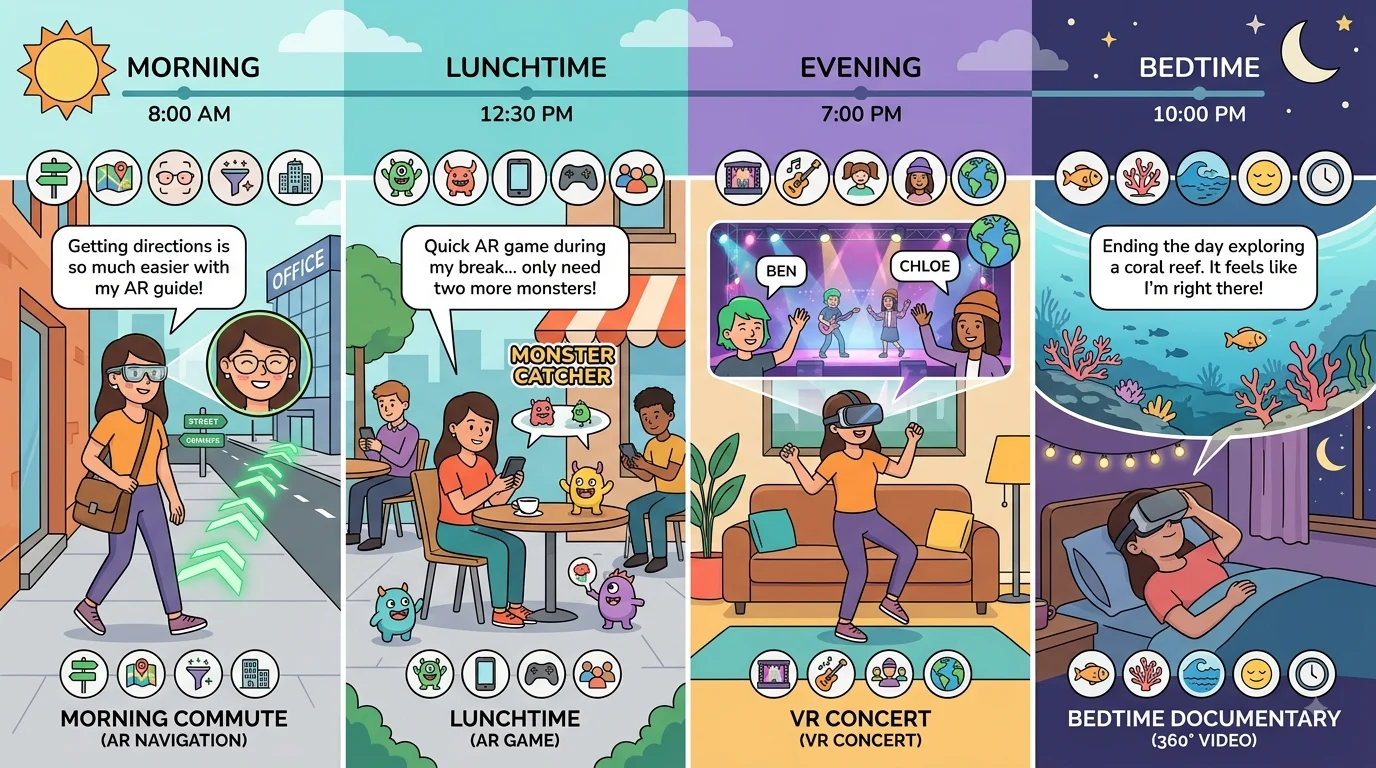
According to Grand View Research, the global VR market may reach $435.36 billion by 2030. The report also attributes factors like gaming and entertainment behind VR software growth.
Reengineering At-Home Entertainment for Immersion
Advances made in the field of spatial audio, visual fidelity, intelligent search and personalisation are contributory factors making it easier for audiences to enjoy at-home entertainment experiences that are not just engaging but also absorbing.
The finest example of this is content discovery, where an AI-powered system helps you find what you want quickly, thus helping you relax the moment before you feel distracted. But this is not what I mean by immersion here. It is all about how you get the experience and where.
It is also worth noting that modern home entertainment technology makes movies and shows sound clearer and look better, which means you can enjoy them at home just like you would in a real movie theater.
What is interesting in this context is the notion that when smart technology learns your preferences and works around them, it will make the entertainment feel natural so you can focus on a story, game or task.
How Different Types of Media Create Immersive Experience of Infotainment
Immersive media is gradually becoming mainstream. This is because viewers are shifting their preference of watching something displayed on a flat TV screen to something in which they can participate virtually by using technologies like AR and VR.
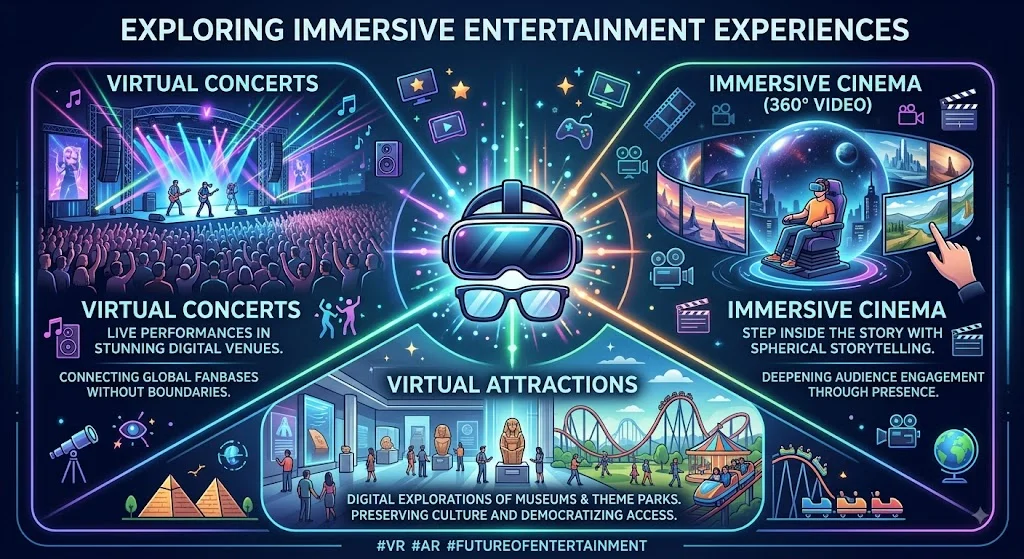
While it doesn't at all mean to say that the mainstream ways of watching films and shows on flat screens are going away permanently, the current trend indicates that immersive media is growing as a preferred choice for viewers who appreciate interactive ways of consuming content or participating in a virtual game.
- Virtual concerts - This form of immersive media is where artists and event organisers use VR to create virtual concert experiences not limited by physical venue capacity. As someone who appreciates this type of entertainment, you can watch an immersive performance from thousands of kilometers away and also experience a sense of spatial presence, something that conventional video streaming can't provide.
- Immersive cinema - 360-degree video and interactive storytelling are finding their relevancy in the priority of filmmakers. Immersive productions gave audiences the opportunity to have a greater control over where they look and what they notice, rather than being forced to look at a single frame.
- Virtual attractions - This form of immersive media is quite helpful for museums, theme parks and cultural organisations to recreate historical environments and fantastical worlds, thus ruling out physical geography to access the entertainment.
More Power to Entertainment Through Augmented Reality for Bigger Everyday Impact
While virtual reality requires users to participate or enter in a digital environment, augmented reality does not impose this sort of restriction. And this is the kind of distinction that is particularly influential in everyday entertainment. You see, AR evolution is making its presence felt almost everywhere.
Smartphones already have all the software and hardware needed to run augmented reality, and billions of people use AR daily without having to buy special glasses. In addition, social platforms now shape how people see and judge the real world, along with changing everyday part of how people take photos and chat online.
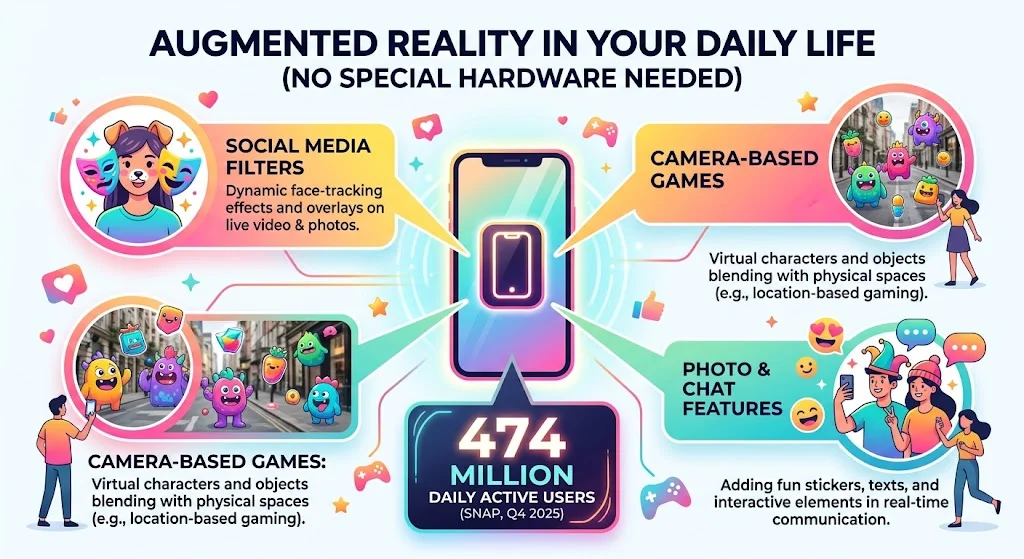
In addition, mobile video games use augmented reality technology so that you can look at virtual characters, items, and creatures as if they exist in the real world next to you.
In this context, the example of Snap is worth mentioning. The scale with which it grew massively large shows how many people use and build things for camera-based apps. Reportedly, it has gathered 474 million daily active users in Q4 2025, providing a great opportunity for audiences who seek AR-powered social and entertainment experiences.
Factors that Make Immersive Media's Direction Hard to Ignore
The worth of AR-guided applications is also being proven outside entertainment. For example, AR-assisted industrial tasks are shown reducing errors by 25% to over 90% depending on the complexity of the task, thereby proving how the same technology that entertains also transforms the work.
The content library is finally catching up to hardware
Early versions of virtual reality failed to grow fast because costly headsets were not well-equipped with good games and apps. The fallout of that was a noticeable slump in sales as buyers would not want to pay higher prices for an empty device. Today, the scenario is different, with major companies pumping billions of dollars to VR native studios to build rich software and launch games on systems.
The device category is breaking into different types
Instead of being limited to just one, device category or technology is breaking into different types, enabling people to choose from smart glasses, mixed-reality headsets to virtual reality units. As a fallout of this diversification, buyers do not have to buy one expensive machine to enjoy digital worlds, making the technology affordable for everyday users.
Enterprise adoption is lowering the risk of technology
Most of the big companies are using virtual and augmented reality daily for work, training and testing. A heavy use of technology like this forces it to improve faster and become very trusted away from video games and movies. These upgrades running behind the scenes make consumer gadgets more affordable, lighter and better for everyday users.
The Role of AI in Immersive Media: More Dynamic Content in the Making?
The role of artificial intelligence in immersive media is going to be massively impactful, perhaps more than what AR or VR hardware could pull off. The technology is capable of generating characters, environments, dialogue, animation and personalised experiences at a scale.
This level of technological prowess means the content production is done faster which otherwise would have required enormous production teams. In other words, creating 3D Animation and virtual environments using AI-powered tools is less of a hassle for creators, whereas for audiences, this could mean more varied and responsive entertainment.
The Biggest Challenges in Immersive Media
While immersive media is hailed as a future of entertainment, it is not without some challenges. Scaling high-bandwidth 3D content without lag, lowering hardware and production costs, and long-term values are some of the challenges worth exploring.
- The hardware barrier - Headsets and advanced AR devices can be expensive, uncomfortable or not easy to use for prolonged use. Other factors that would influence the adoption of immersive media include battery life, weight, field of view and processing requirements.
- Complex content production - Creating high-quality immersive content is not an easy task as it requires 3D artists, developers, technical directors, spatial-audio specialists and other professionals.
- Motion sickness and comfort - VR developers must design carefully, as any sort of delays, camera movement, or mismatched sight and sound, causing discomfort or motion sickness to the users.
- Privacy concerns - AR glasses and spatial-computing devices are suspected to collect data about users, environments and physical surroundings, thus requiring in place data governance and privacy.
Final Words: The Future of Immersive Entertainment
Virtual reality is believed to represent the most personalised form of immersive entertainment by completely immersing users in a digital world. On the other hand, augmented reality is more accessible for everyday use, improving the real world without requiring the users to disconnect from their surroundings.
To be noted here is that immersive media is not a replacement for traditional entertainment. It is expanding the definition of what entertainment means. For example, a virtually streaming concert can now be a shared virtual space for audiences. A film can become a world for you when you step inside rather than watch what it reveals.
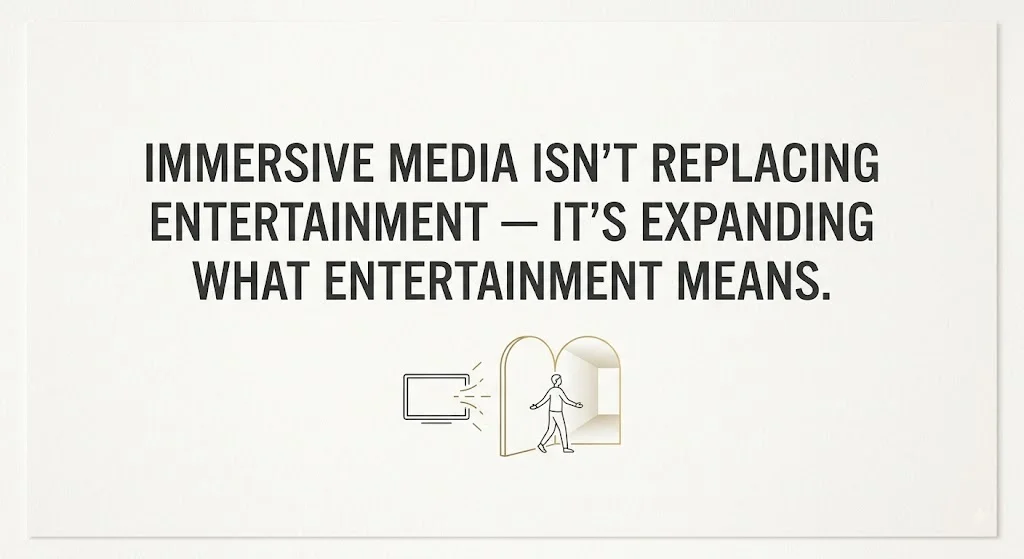
If we talk about the biggest driver of immersive entertainment, we can’t attribute it to a single software or hardware. It is all about audience behavior and how quickly we adapt. In a world saturated with noise and distraction, the future of entertainment would not be about escaping reality but about finding a connection where attention becomes the ultimate luxury.

The EIMT Editorial Team is made up of academic editors, faculty contributors, curriculum specialists, instructional designers, education researchers, programme managers, quality assurance professionals, content strategists, and subject matter experts...
Latest Updates & Articles
Stay Connected !! To check out what is happening at EIMT read our latest blogs and articles.


Sep 10, 2026

Sep 10, 2026