


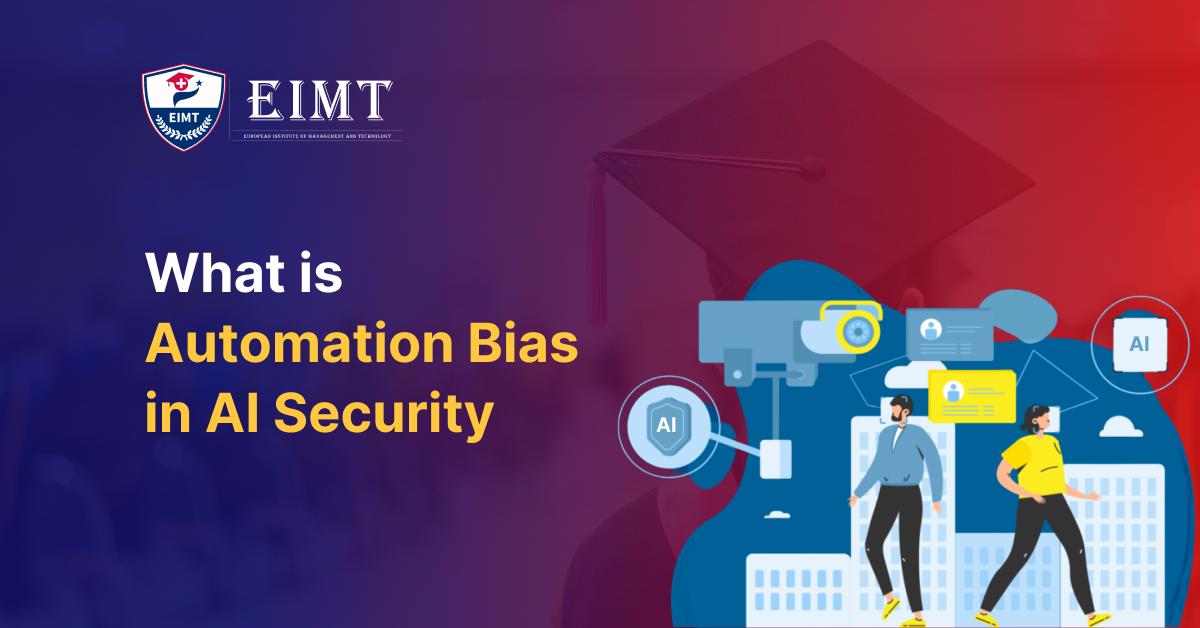
What is Automation Bias in AI Security
Home / What is Automation Bias in AI Security
Artificial Intelligence
Nobody really talks about Automation Bias in AI security. Even though artificial intelligence is now monitoring our emails, protecting our bank accounts, filtering the content that is online, and securing companies from cyber attacks.
We are often told that AI is faster than humans, Smarter than humans. More accurate than humans.
And while all that may be true, there is one uncomfortable truth that we often choose to ignore:
AI is still built by humans, trained on human data, and trusted by humans. And that trust, when left unchecked, can quietly become a risk.
Automation bias is exactly that risk. It happens when people stop questioning AI decisions and begin accepting them as "correct" by default. In security systems, this can mean missed threats, false alarms, or dangerous decisions going unnoticed simply because "the system said so."
Just as nobody questions Google Maps when it suggests a turn that is wrong, many security systems today depend on AI alerts without questioning whether they actually make sense.
And that's where the problem begins.
What do we Understand by Automation Bias?
Automation bias is a human behaviour, and not a technical failure. Automation bias occurs when people overtrust automated systems and disregard their own judgement, even if something doesn't seem right. When the AI provides a solution, people believe it to be right.
In AI security, automation bias shows up when:
- Security teams accept AI alerts without reviewing them
- Analysts ignore suspicious activity because the system didn't flag it
- False positives are trusted more than human intuition
- Human oversight slowly fades away
Thus, automation bias, in simple words, is blind trust in machines.
AI doesn't get tired, emotional, or distracted. However, it doesn't fully understand the context the way humans do. When humans stop double-checking AI, small errors can turn into big security gaps.
Read also - Artificial Intelligence Blog and Articles
Why Automation Bias is Growing in AI Security
Automation bias isn't new, but it is growing faster than ever. That's because AI systems are now deeply involved in security decisions.
Several factors are driving this problem:
1. AI Feel Authoritative
AI systems frequently provide results with confidence—scores, warnings, or labels. When a machine speaks with certainty, people believe it.
2. Speed Over Judgement
AI works faster than any human team. When speed becomes the priority, human review is often skipped.
3. Complexity of AI Models
Several AI security tools are difficult to comprehend. When people don't understand how a decision was made, they are less likely to challenge it.
4. Overworked Security Teams
Security professionals handle thousands of alerts daily. Thus, trusting AI feels like relief, even when it shouldn't be.
Over time, this creates a habit of dependence instead of partnership.
What is Bias and How Is It Connected?
To understand automation bias, we must first understand AI bias.
So, AI bias occurs when an AI system produces unfair, inaccurate, or misleading results. This usually happens because the data used to train AI is flawed or incomplete.
Automation bias makes AI bias more dangerous. Why?
Because when people trust AI blindly, they also trust its biases blindly.
If an AI system is biased and humans don't question it, that bias quietly spreads into decisions that affect real people and real systems.
Common Causes of AI Bias
Bias in AI does not occur randomly. It normally results from a number of sources like:
- Biased training data
- When past data is biased in some way, AI systems reproduce the same biases.
- Incomplete data
- When some behaviors, regions, or users are not well-represented or remain underrepresented, AI systems make incorrect assumptions.
- Human design choices
- Developers determine what data is important and what is not.
- Feedback loops
- Decisions made by AI systems affect future data, leading to the same errors being perpetuated again and again.
When automation bias is present, these errors are rarely questioned.
Types of AI Bias in Security Systems
AI bias in security doesn't look dramatic or obvious. Most of the time, it hides inside everyday processes and normal system behavior. That's what makes it risky.
Below are some common types of AI bias in security systems:
1. False Positive Bias
False positives happen when an AI system flags harmless activity as a security threat. At first, this may seem safe—after all, catching "too much" feels better than missing something . But over time, repeated false alerts create unnecessary fear, wasted effort, and blind trust in the system.
Example:
An employee logs in from a hotel Wi-Fi while traveling work. The AI security system sees a new location and instantly flags the login as a potential attack. The account gets temporarily blocked, even though the employee is legitimate.
After seeing many such alerts, security teams stop questioning them and assume the AI must be right every time. This is where automation bias begins.
Impact:
- Legitimate users get blocked
- Productivity suffers
- Teams trust alerts without verification
2. False Negative Bias
False negatives are often more dangerous than false positives. This happens when the AI fails to detect a real threat, humans assume everything is fine simply because there was no alert.
When automation bias exists, "no warning" is treated as "no risk."
Example:
A cybercriminal uses a slow, low-profile attack that closely mimics normal user behavior. Because the activity doesn't match known attack patterns, the AI security system does not flag it.
The security team trusts the system and does not investigate further. By the time the breach is discovered, sensitive data has already been accessed.
Impact:
- Real attacks go unnoticed
- Delayed response increases damage
- Overconfidence in AI systems grows
3. Data Bias
Data bias occurs when an AI system is trained on limited or outdated data. If the system has mostly seen certain types of attacks, it becomes good at spotting only those—and blind to others.
Automation bias makes this worse because humans rarely question what the AI hasn't learned.
Example:
An AI security tool is trained mostly on past phishing attacks from email. When attackers shift to messaging apps or collaboration tools, the system struggles to detect the new threat style.
Security teams assume the system covers all risks, even though it was never trained for these newer attack methods.
Impact:
- New or rare threats are missed
- Attackers exploit blind spots
- Security feels strong but isn't
4. Context Bias
Context bias occurs when AI fails to understand the full situation behind an action. AI sees patterns, not intentions, emotions, or sudden changes in behavior.
Humans can often sense when something "feels wrong", however AI cannot.
Example:
A senior employee suddenly starts downloading large amounts of internal data late at night. The AI sees this as normal behavior because the employee has high-level access.
A human reviewer, however, might question the unusual timing or change in behavior. But due to automation bias, the alert is never reviewed.
Impact:
- Insider threats go unnoticed
- Behavioral changes are ignored
- Context-based risks are missed
Read also - Types Of AI | Artificial Intelligence
How Automation Bias Affects AI Security
Automation bias can quietly weaken security instead of strengthening it.
Here's how it plays out in real environments:
- A phishing email bypasses detection because the AI didn't flag it
- A real cyberattack is ignored because it looks "normal" to the system
- Legitimate users are blocked because the AI labeled them risky
- Security teams stop questioning alerts and start reacting blindly
Over time, security becomes reactive instead of thoughtful.
The system is working, but the thinking is gone.
Industries Most Affected by Automation Bias
Automation bias doesn't affect all industries equally. Some sectors feel it more strongly than others.
Banking and Finance
AI handles fraud detection, transaction monitoring, and account security. Automation bias can lead to:
- Legitimate transactions being blocked
- Real fraud being missed
- Loss of customer trust
Healthcare
AI monitors patient data and system access. Automation bias can result in:
- Delayed response to real threats
- Over reliance on automated alerts
- Privacy risks
E-commerce and Retail
AI manages payments, fraud checks, and customer behavior. Automation bias can:
- Block real customers
- Miss coordinated attacks
- Reduce user experience quality
Government and Public Services
AI is used for surveillance and cybersecurity. Automation bias can:
- Create unfair monitoring
- Miss advanced
- Reduce accountability
Real-World Impact of Automation Bias
The actual danger of automation bias isn't just technical failure. It's human behavior.
When people stop questioning AI:
- Errors go unnoticed
- Bias becomes normalized
- Accountability becomes unclear
- Security decisions lose transparency
AI is meant to assist humans, not replace their judgment.
How to Reduce Automation Bias in AI Security
The good news is that automation bias is manageable.
Here's what helps:
- Keep Humans in the Loop
AI decisions should always be reviewed, especially high-risk ones.
- Encourage Questioning
Teams should feel comfortable questioning AI outcomes without fear.
- Regular Audits
AI systems need regular checks to identify bias and blind spots.
- Clear Explanations
Security tools should explain why a decision was made, not just what it decided.
- Training People, Not Just Systems
Humans must be trained to work with AI, not surrender to it
Concluding Thoughts
Automation bias in AI security is quiet, subtle, and dangerous precisely because it feels convenient.
AI doesn't need blind trust. It needs smart supervision.
When humans stay involved, question outcomes, and understand limits, AI becomes a powerful ally instead of a silent risk. This is very important point to understand and discuss among ourselves—before trust turns into trouble.

The EIMT Editorial Team is made up of academic editors, faculty contributors, curriculum specialists, instructional designers, education researchers, programme managers, quality assurance professionals, content strategists, and subject matter experts...
Frequently Asked Questions
Why is automation bias dangerous in cybersecurity?
What causes automation bias in AI systems?
Which industries are most affected by automation bias?
How does automation bias lead to false positives and false negatives?
How can organizations reduce automation bias in AI security?
Why is human oversight important in AI security systems?
Can automation bias affect AI decision-making in other industries?
How does AI training data contribute to automation bias risks?
What is the role of explainable AI in preventing automation bias?
Latest Updates & Articles
Stay Connected !! To check out what is happening at EIMT read our latest blogs and articles.

Sep 10, 2026
Sep 10, 2026


Aug 31, 2026