
PMP Exam Revision in 2026: Updated Domains, Exam Structure, and Eligibility Criteria
Home / PMP Exam Revision in 2026: Updated Domains, Exam Structure, and Eligibility Criteria
Management
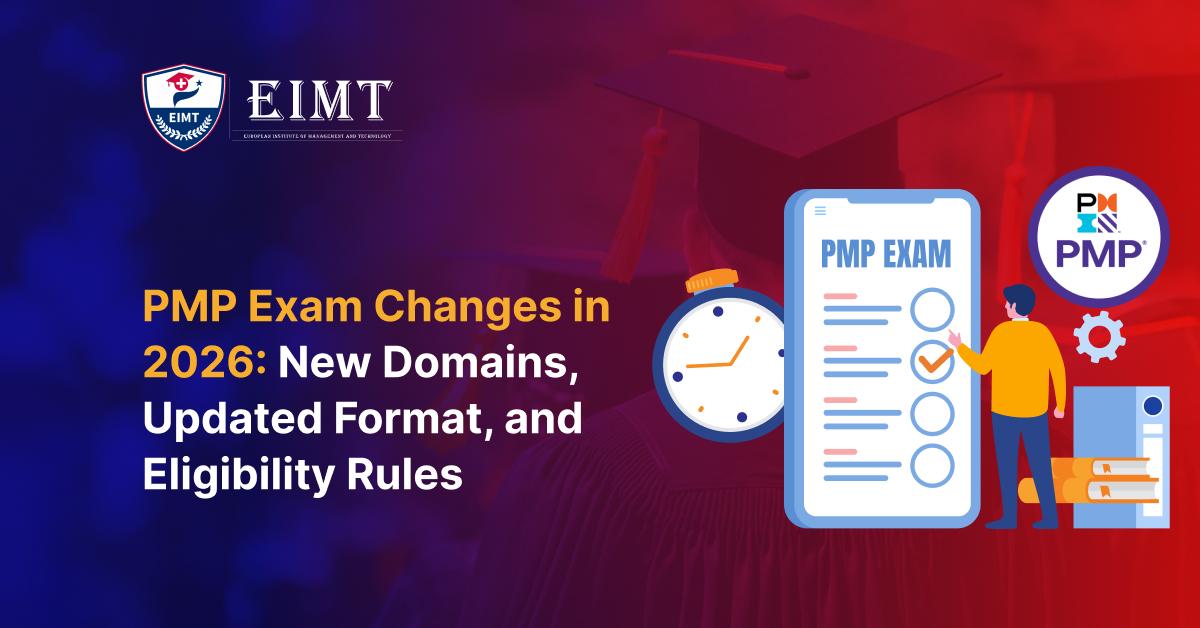
The 2026 PMP exam introduces a new structure, updated question formats, and revised eligibility requirements, reflecting current project management practices worldwide. Candidates who prepare early, understand the new domains, and align their training with PMI's updated expectations will stay ahead of the change.
The PMP exam will shift to a new structure in July 2026. PMI designed this update to align with current project expectations worldwide, where teams rely on clearer delivery methods, structured decision-making, and strong business alignment. According to the U.S. Bureau of Labor Statistics, project-oriented roles continue to expand across technology, healthcare, and construction.
The whole article sticks to current guidance from PMI and the 2026 rollout schedule. If you want to stay ahead, you must adjust your study plan, understand the new domains, track the updated timeliness, and prepare for the revised task expectations PMI confirmed.
Official PMP Exam Launch Date: PMI confirmed that the new PMP exam will go live globally in July 2026. All testing centers and online platforms will switch to the updated format at that time.
Key Details for PMP July Exam, 2026:
- Complete switch to the new exam pattern
- Updated domain distribution
- New scenario-based and interactive questions
- Increased focus on business-centered project decisions
Domain Changes in the 2026 PMP Exam
The 2026 PMP exam updates the domain weightings and shifts how project knowledge is measured. PMI confirmed these changes through the official PMP Exam Update announcement.
Before/After Domain Weighing Percentage
|
Domain |
Pre-July 2026 Weightage |
After July 2026 Weightage |
|
People |
42% |
33% |
|
Process |
50% |
41% |
|
Business Environment |
8% |
26% |
Why the Business Environment Domain Expands: PMI expanded this domain to measure the skills required in the project environments. Organizations expect project leads to:
- Understand financial impact
- Support value-based decisions
- Align project outcomes with organizational direction
High-Impact Theme PMP Updates
PMI added new content areas that appear across scenarios and tasks:
- AI and automation are integrated into planning and reporting
- Hybrid and adaptive delivery used across U.S. projects
- Outcome-based delivery tied to measurable value
- Sustainability-related considerations were added to project responsibilities.
These updates reflect topics PMI included in the revised exam outline.
Exam Format and Question Types for the 2026 PMP
The PMP exam has had a stable structure since the 2021 exam update. However, the 2026 PMP exam adjusts multiple elements, including question volume, scoring, structure, and how candidates interact with scenarios. These updates come from PMI communications, PMI chapters, and exam-preparation sources that track blueprint changes.
|
Feature |
Previous PMP Exam (2021-2025) |
2026 PMP Exam |
|
Total Questions |
180 |
180 |
|
Scored Questions |
175 |
170 |
|
Pretest (Unscored) |
5 |
10 |
|
Time Duration |
230 minutes |
240 minutes |
|
Breaks |
Two breaks after each section |
Structured breaks between sections |
|
Structure |
Three sections |
Three sections with section-specific |
|
Scenario Blocks |
Short text scenarios, 2–3 questions per block, limited visuals or tables |
Detailed business scenarios, including cases, project calendars, Gantt segments, Agile burn-down/velocity charts, budgets, change requests, stakeholder logs, and issue trackers |
|
Graphic/Visual Items |
Some Earned Value tables, light process diagrams, and simple charts |
Flowcharts with multiple missing steps, swim lane diagrams, escalation paths, compliance dashboards, performance trend charts, quality control charts, Agile forecasting visuals, and detailed stakeholder maps |
|
Impact on Candidates |
Focus on memorization and basic situational judgment. |
Focus on applied decision-making, multi-document interpretation, scenario analysis, chart and visual interpretation, agile/hybrid context, and business alignment decisions. |
Question Formats Confirmed for 2026
The exam uses a mix of established and newly introduced item formats:
- Multiple-choice
- Multiple-response
- Matching
- Drag-and-drop
- Hotspot (click on a specific point in a diagram)
- Pull-down selections
- Fill-in-the-blank
- Scenario clusters with several linked questions
- Graphic-interpretation items
PMI introduces these formats to measure reasoning, sequencing, and choice selection under structured scenarios.
PMBOK Guide 8th Edition Update
PMI released the PMBOK Guide 8th Edition to support the 2026 PMP exam changes. This edition moves away from long process charts and shifts toward decision-focused guidance, value delivery, adaptive planning, and stronger direction on stakeholder expectations. It expands coverage of predictive, agile, and hybrid delivery, updates the project flow process, and provides clearer direction on business alignment and leadership behaviors.
Updated Eligibility & Experience Requirements for PMP (2026)
PMI revised its eligibility rules when it issued the 2026 exam update. These changes aim to align eligibility globally, recognize broader education paths, and allow a longer experience window.
Note: All project management experience must be within the last 10 years to be considered for the application.
1. Education and Professional Experience Requirements
Candidates must meet one of the following education and experience paths:
|
Educational Background |
Required Project Management Experience (non-overlapping) |
|
Upper-secondary/high school diploma/GED (EQF level 4/ISCED 3-4) |
60 months (5 years) |
|
Recognised associate-level, advanced technical, or vocational program (EQF Level 5/ISCED 5) |
48 months (4 years) |
|
Bachelor's degree or higher (EQF Level 6/ISCED 6) |
36 months (3 years) |
|
Bachelor's or postgraduate degree accredited by PMI's Global Accreditation Center (GAC) |
24 months (2 years) |
Important Points:
- Experience must involve leading and directing projects.
- Projects are defined as temporary initiatives with a unique context designed to create value. They may be standalone or part of a program/portfolio.
- Non-degree qualifications are eligible only if they are explicitly mapped to EQF Level 6 or the national bachelor's equivalent level. Titles like "advanced" or "professional" without official mapping are insufficient.
- If selected for an audit, candidates must provide documentation that verifies their education and experience.
2. Commercial Training Requirements
Candidates must complete at least 35 hours of project management training aligned with the PMP Exam Content Outline (ECO).
Acceptable training sources include:
- PMI Authorized Training Providers (ATP)
- PMI Global Accreditation Center (GAC) programs
- Employer- or company-sponsored courses
- Accredited higher-education institutions
- Training companies or consultants
- Self-paced online courses with end-of-course assessment
Important Notes:
- Training hours must be verifiable and cover topics in the ECO, including scope, schedule, risk, procurement, financials, stakeholder management, integration, and governance.
- Books or practice exams do not count toward training hours.
- One hour of instruction equals one training hour. Partial course hours count only if directly related to project management.
3. Credit for Prior Learning
- Active CAPM holders automatically receive 23 hours of credit toward commercial training. Only 12 additional hours aligned to ECO are required.
- Graduates of GAC-accredited degree programs may count completed coursework toward the 35-hour requirement.
4. Verification and Audit Process
All candidates may be selected for an audit to verify education and professional experience.
If a credential does not specify a framework level, candidates must provide:
- Link/extract from a national qualifications register, or
- Official confirmation from the awarding body or ministry, or
- Evaluation by a recognized national authority
PMI aligns this process with ISO/IEC 17024:2012 standards to maintain integrity.
Read Also: Online (PMP)® Certification Training Courses: How to Get a PMP Certification
Updated PMP Transition Timeline
|
Date/Period |
PMI Action |
What This Means for Candidates |
|
15 Dec 2025 |
Registration opens for the pilot version of the new PMP exam |
|
|
5-30 Jan 2026 |
Pilot exam window (English only) at Pearson VUE test centers. Includes a 20% rebate + free retake if the pilot attempt is not passed |
|
|
April 2026 |
PMI releases updated prep material: guides, practice sets, on-demand lessons, and instructor-led sessions |
|
|
July 2026 |
Full global rollout of the updated exam. The old version retires. (EXACT CUTOFF Day Still Pending) |
|
How to Record Your Experience and Education in the PMP Application
PMI requires you to record professional work where you led and directed project tasks. Your experience can be paid or unpaid, but it must occur in a professional environment.
Valid examples:
- Leading projects at work
- Managing project phases, teams, budgets, schedules, or deliverables
- Directing work tied to project goals, timelines, or outcomes.
Not valid:
- School projects
- Academic research for degree requirements
- Planning personal events
- Home improvement or personal tasks
- Routine, operational, or administrative duties
Only record work that reflects project leadership in a business setting.
How does PMI calculate project months?
PMI counts months, not the number of projects.
If multiple projects overlap, you cannot double-count the same time period.
|
Project |
Dates |
Counted Months |
Reason |
|
Project I |
1 Jan-31 Mar |
3 months |
January, February, March |
|
Project II |
1 Feb - 31 May |
2 months |
Only April and May can be added because Feb-Mar overlap with Project I |
|
Total credited |
- |
5 months |
January-May = 5 unique months |
What if you haven't yet met the PMP requirements?
If your experience in months falls short of the required minimum, PMI recommends pursuing the CAPM certification. CAPM helps you build project management knowledge while you continue to gain the necessary experience for PMP certification.
FAQs
Will the PMP exam change in 2026?
Yes. PMI will release a new PMP exam version in July 2026. The update introduces new domain weightings, expanded coverage of the business environment, deeper scenario blocks, new graphic-based items, and revised eligibility rules.
Is a score of 70% enough to pass the PMP?
PMI does not publish a fixed passing score. Candidates are evaluated based on a scaled model that assesses performance across all domains. Many training providers estimate a target score near the 70% range during practice tests, but the actual exam uses a scoring system that adjusts for question difficulty.
Does the PMP exam have negative marking?
No. PMI counts only correct responses. Wrong answers do not reduce your score, so it helps to answer every item.
Is PMP still worth it in 2026?
Yes. Employers across the U.S. continue to request the credential for project-focused roles. It strengthens credibility, raises the earning power, and improves access to higher-level roles across industries such as tech, healthcare, construction, consulting, and finance.
Can I pass the PMP in 3 months?
Yes, if you follow a structured and disciplined plan.
How to get 35 hours for PMP?
You can earn the 35 training hours from PMI Authorized Training Providers, accredited universities, employer-sponsored learning, training companies offering on-demand or instructor-led courses, and GAC-accredited degree programs. CAPM holders receive 23 hours of credit and need only 12 more. PMI accepts multiple formats as long as the content aligns with the PMP Exam Content Outline.
How many attempts at PMP?
PMP provides three attempts within one year (exam eligibility period). If you do not pass within those three attempts, you must reapply and pay the re-examination fee after PMI approves the new application.
Will PMP expire?
Yes. PMP stays active for three years. You must earn 60 Professional Development Units (PDUs) during that period. If you do not meet the renewal requirement, your credential will be suspended and later transition to inactive status until it is renewed.
What salary can I expect with a PMP?
PMP credential holders in the United States report higher earnings across most industries. Many national compensation surveys indicate an average annual pay range of $120,000 to $130,000, with experienced practitioners earning more in roles involving leadership, compliance oversight, or program-level responsibilities. Actual pay varies by state, industry, experience, and job scope.
References:
July 2026 PMP® Certification Exam Update
The EIMT Editorial Team is made up of academic editors, faculty contributors, curriculum specialists, instructional designers, education researchers, programme managers, quality assurance professionals, content strategists, and subject matter experts...
Frequently Asked Questions
What are the new PMP exam changes 2026 candidates face?
How does the PMP exam structure 2026 scale unscored questions?
Why did the PMP business environment domain percentage expand?
How does the PMBOK 8th edition PMP exam text shift core guidance?
What are the updated PMP eligibility requirements 2026 frameworks mandate?
What satisfies the pmp training hours requirement for certification?
What is the official PMP transition timeline 2026 rollout schedule?
How does PMI calculate non-overlapping experience months for applications?
Which new question types are on the 2026 project test?
Is the 2026 project management exam harder to pass?
Latest Updates & Articles
Stay Connected !! To check out what is happening at EIMT read our latest blogs and articles.





Sep 10, 2026

Sep 10, 2026